Certify Noise & Vibration Criteria
Before Deployment.
Many manufacturing machines require pre-delivery certification to assure compliance with specified noise and/or vibration specifications. Memtech Acoustics has the in-house expertise to quickly execute any required testing to meet these standards, and to supply compliant documentation as needed.

Certify Before You Operate.
Original equipment manufacturers (OEMs) and system integrators, typically are required to meet customer-specified noise and vibration criteria prior to delivery. This is intended to assure that the equipment does not exceed the desired noise target for the end-user plant, or that excessive vibration does not cause part quality or reliability concerns.
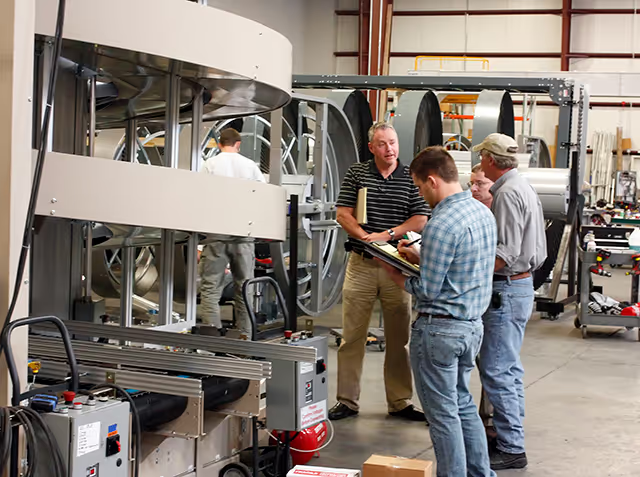
At Memtech Acoustics, our Machine Run-Off Validation services, FAT (Factory Acceptance Testing), or SAT (Site Acceptance Tests), provide accurate noise and/or vibration certification in compliance with customer specifications. We have worked directly with many OEMs and end-users, and are familiar with the testing requirements
At Memtech Acoustics, our Machine Run-Off Validation services, FAT (Factory Acceptance Testing), or SAT (Site Acceptance Tests), provide accurate noise and/or vibration certification in compliance with customer specifications. We have worked directly with many OEMs and end-users, and are familiar with the testing requirements
We test both standalone machines and systems integrated into larger production lines or test cells.
Our Testing Services
We utilize calibrated, NIST-traceable equipment and conform with ISO testing methodologies to assure that the certifications will meet or exceed the end-users specifications.
Sound Level Certification
Measurement of machine noise output under required operating conditions, including long-cycle CNC machine systems.
Sound Power Testing
Using acoustic-intensity methods, we can determine the total sound power of a machine or system, presented in any desired format.
Vibration Certification
We can perform appropriate vibration validation testing, to overall, band-limited, or full spectral requirements. Modal testing is also available.
Remediation Support
In the event that tests fail any element of the specified criteria, we can provide technical support to determine root-causes.
Test Reports and Certificates
Documented test procedures, measurement conditions, compliance evaluations, and pass/fail certifications are supplied for all tests.

Machine ACCEPTANCE testing
Our Approach & Capabilities
Memtech Acoustics' run-off testing services span the full spectrum of industrial and automation equipment.
We conduct Factory Acceptance Tests (FATs) for pre-shipment validation, or Site Acceptance Tests (SATs) post-installation, capturing noise levels and vibration profiles.
We then deliver fully documented results, including run-off checklists, acoustic reports, and compliance certifications.
We conduct Factory Acceptance Tests (FATs) for pre-shipment validation, or Site Acceptance Tests (SATs) post-installation, capturing noise levels and vibration profiles.
We then deliver fully documented results, including run-off checklists, acoustic reports, and compliance certifications.
Our approach:
- FAT or SAT Execution
Whether at the OEM facility or your site, we replicate real-world operating conditions to test cycles, control functions, and acoustic behavior. - High-Fidelity Noise & Vibration Monitoring
Using Class 1 sound meters and accelerometers, we capture tonal spectra, broadband emissions, and structural resonances throughout run-off. - Performance Mapping & Statistical Validation
We assess equipment stability using metrics like Cpk, Ppk, and measurement system analysis (MSA) to confirm repeatability and quality. - Customization & Collaboration
We integrate run-off plans into your project timeline, coordinate with OEM partners, and adapt tests around your operation readiness. - Turnkey Reporting
Detailed reports validate acoustic/vibration performance, safety adherence, and functional milestones with actionable findings and pass/fail documentation.
Who Needs Machine Runoff Testing?
- OEMs preparing for factory acceptance testing (FAT)
- Integrators certifying systems for end-users
- Manufacturers purchasing new equipment
- Maintenance teams verifying machine upgrades or rebuilds
- Consultants supporting warranty or regulatory compliance
How Every Project Runs
From Requirement to Verified Result
Memtech Acoustics runs every engineering project on the same model. The left side defines the result: what the problem is, what the space or equipment must measure once it is fixed, and how the design gets there. The right side proves it. Each check on the way up is measured against a decision made on the way down. Every measurement follows one plan, set before any data is taken, so the final result compares directly with the starting point.
Run-off testing is verification: it proves a machine meets its purchase specification before or after delivery.
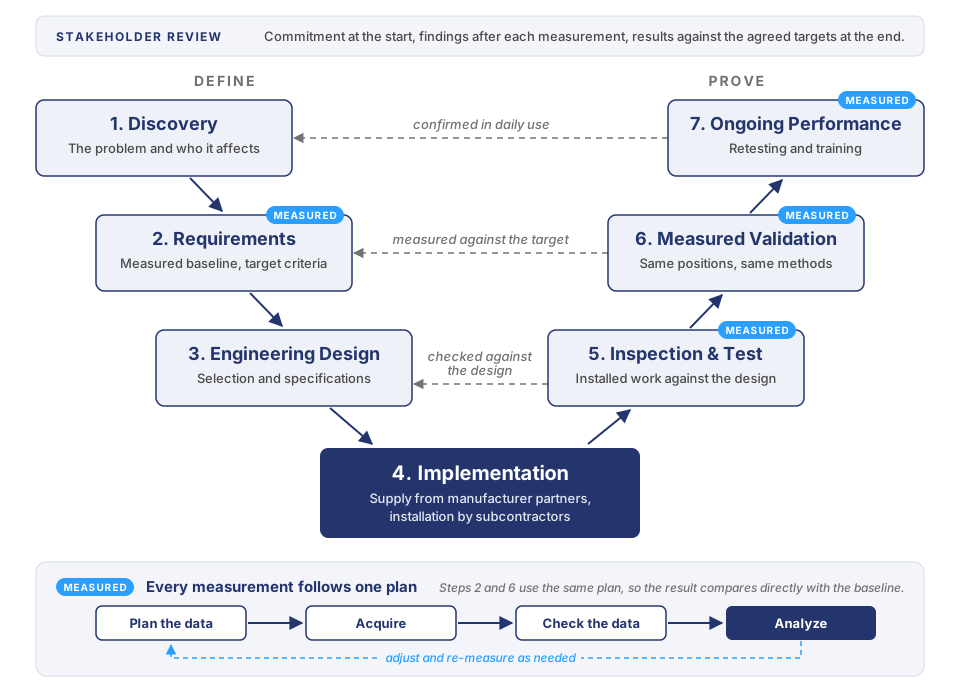
1. Discovery: the problem and who it affects.
2. Requirements: a measured baseline and the target criteria.
3. Engineering design: treatment selection and specifications.
4. Implementation: supply from manufacturer partners, installation by subcontractors.
5. Inspection and test: installed work checked against the design.
6. Measured validation: same positions and methods, measured against the target.
7. Ongoing performance: retesting and training as operations change.
Every measurement: one plan, set before any data is taken. Plan the data, acquire it, check it, then analyze it, and re-measure as needed. Steps 2 and 6 use the same plan.
Stakeholder review: commitment at the start, findings after each measurement, results against the agreed targets at the end.
Some engagements cover one part of the model, such as a test or a design review. The model shows where that part fits, and what comes before and after it.
- Checked before it is used: every measurement is reviewed for calibration, gaps and duplicate readings before any result is drawn from it.
- Checked against the design: inspection and testing confirm the installed work matches the specified assemblies and details.
- Measured against the target: validation repeats the baseline measurement at the same positions with the same methods, and compares the result with the requirement.
- Confirmed in daily use: retesting and training keep the result in place as operations change.
Our Testing Process
Baseline Noise Measurement
Memtech Acoustics establishes ambient and background noise levels at the test site to ensure accurate source-level measurements and separate the machine's level from background noise in the final data.
Frequency and Tonal Analysis
Octave band and narrowband frequency analysis identifies the spectral content of machine noise, isolating tonal components that may indicate mechanical issues or exceed specification limits.
Source-Level Evaluation
Using calibrated Class 1 instrumentation, Memtech Acoustics measures noise and vibration at operator positions and near-field locations per ISO 11201 and ISO 3744 methods.
Performance Verification
Test results are evaluated against the end-user's acceptance criteria, with pass/fail determinations supported by statistical analysis including Cpk/Ppk process capability metrics where required.
Corrective Guidance
If equipment exceeds specified limits, Memtech Acoustics provides diagnostic findings identifying root causes and recommends targeted corrective actions before retest.

Machine ACCEPTANCE testing
Test Conditions and Measurement Positions
A run-off result is only as valid as the conditions the machine ran under. Memtech Acoustics tests with the machine running like production: parts flowing, tooling engaged, and auxiliary equipment such as filters and blowers on. A machine with a variable-speed drive is tested at its actual operating point, and the full cycle is captured, because idle, cutting and retract can produce very different levels.
Positions follow the specification. On a typical run-off they sit on an envelope 1 meter from the machine at 1.5 meters above the floor, plus the operator's position, and each reading covers at least one complete machine cycle. Memtech measures the distances rather than estimating them.
Positions follow the specification. On a typical run-off they sit on an envelope 1 meter from the machine at 1.5 meters above the floor, plus the operator's position, and each reading covers at least one complete machine cycle. Memtech measures the distances rather than estimating them.
Measurement controls:
- Background check: background is measured at the same positions with the machine off. If it is within 3 dB of the machine's level, or the margin the specification sets, nearby sources are stopped or the test moves to a quieter off-shift period.
- Background correction: applied only as the specification directs, and shown on the data sheet beside the raw reading.
- Calibration: a field check with an acoustic calibrator before and after each session. Accelerometers are checked with a handheld vibration calibrator.
- Instruments: Class 1 sound level meters for noise. For vibration, accelerometers mounted by magnet, adhesive, wax or stud to suit the surface.
- Unreachable positions: never estimated. They are marked N/A with the reason.
- Vibration results: reported in the form the specification calls for, as overall, octave-band or narrowband (FFT) levels.
Standards and Compliance
Memtech Acoustics conducts all machine acceptance testing in accordance with recognized national and international standards. Every measurement uses NIST-traceable, Class 1 instrumentation to produce defensible, audit-ready results.
- OSHA 29 CFR 1910.95
Occupational noise exposure limits and hearing conservation requirements for worker safety compliance. - ISO 11201
Sound pressure level measurement at operator positions under standardized conditions for equipment acceptance. - ISO 3744
Sound power level determination for equipment noise characterization and comparison against manufacturer specifications. - ANSI S12.19-1996
Measurement of occupational noise exposure using calibrated instrumentation and documented procedures. - NIOSH Recommended Exposure Limits
More conservative exposure criteria used alongside OSHA limits for enhanced worker protection.
Machine ACCEPTANCE testing
What You Receive
Memtech Acoustics reports run-off results on the end user's own certification forms or in a stand-alone engineering report, whichever the specification calls for. Every reading traces to a position, an operating condition and a calibrated instrument. The data is signed as true and accurate, provided the machine ran in its representative condition during the test.
The first page states the result: pass or fail against the specified limit.
The first page states the result: pass or fail against the specified limit.
Each run-off report includes:
- Pass/fail summary: the result against each specified limit.
- Machine diagram: a plot plan of the machine and its auxiliary equipment, with every measurement position numbered.
- Position-by-position data: background level, level with the machine operating, sample duration, any background correction, corrected level, and C-weighted peak at each position.
- Test conditions: the operating mode and cycle during each reading, with any position that could not be reached marked N/A and the reason given.
- Instruments and calibration: each instrument's model, serial number and calibration dates, with the calibration files and a description of the method.
- Exceedances and next steps: any reading over the limit, its probable cause, and corrective actions before a retest.
- Review meeting: one follow-up call to go over the findings.
Past Projects and Applications
Memtech Acoustics has completed machine acceptance testing across automotive, energy, emergency vehicle, and industrial manufacturing sectors.
ABB Parts Washer - Ford Manufacturing
Noise control testing and certification for an ABB industrial parts washing system installed at a Ford manufacturing facility, verifying compliance with plant noise specifications.
SoundOff Signal - Emergency Siren Testing
Anechoic chamber testing for emergency vehicle siren systems, verifying acoustic output and directivity patterns under controlled laboratory conditions.
Magna Cosma - Body Assembly Enclosures
Acoustic enclosure design and noise verification for automated body assembly equipment at a Magna Cosma automotive production facility.

The Memtech Difference
At Memtech, noise is our business. Our engineers oversee every step, ensuring that each project is properly delivered, on-time and within budget. This integrated approach delivers predictable results and protects your investment.

Certified Acoustic Professionals
Testing conducted by certified engineers and acoustic specialists, not general contractors or “safety consultants.”

National Standards Alignment
We follow OSHA 1910.95, NIOSH criteria, and ANSI S12.19-1996 methods for noise exposure assessment. Measurements are conducted via ISO procedures or per academically accepted methods.

Engineering Expertise
Noise measurements, analysis, modeling and installation support are overseen by professionals who understand acoustic theory, as well as the implementation of practical solutions.
High Responsiveness, Proven Reliability
We are your trusted local partner providing on-demand support and dependable project execution. Michigan-based with regional reach and national* shipping capabilities.

Confidential & Detailed Reporting
We don’t just submit a report. You are provided with complete documentation, delivered in easy-to-understand language with accurate data and comprehensive drawings.
*Shipping available across the continental USA, and international; installations are offered in select regions.
NOTE: We do not stock custom products in our U.S. warehouse. Ask us about lead times for your project.
NOTE: We do not stock custom products in our U.S. warehouse. Ask us about lead times for your project.

Machine ACCEPTANCE testing
When Run-Off Testing Is Not the Right Service
A run-off test measures what one machine emits at defined positions, against a purchase specification. It does not measure what a worker receives over a shift, and it does not fix a machine that fails. Memtech Acoustics will point you to the right service for those questions.
Other services to consider:
- Worker exposure over a full shift: that is personal dosimetry under OSHA 29 CFR 1910.95. See noise exposure testing.
- A machine in service that vibrates, wears early or makes parts out of tolerance: finding the cause is vibration analysis.
- A machine that failed and needs a fix: the run-off data guides the design of an enclosure, barrier or silencer. See engineered noise control systems.
- A product that must be measured in a qualified test room: some test codes call for an anechoic or hemi-anechoic room. Memtech Acoustics designs and qualifies those rooms; see anechoic and hemi-anechoic chambers.
Frequently Asked Questions (FAQs)
What is a machine noise or vibration run-off test?
A run-off test is a structured measurement sequence, defined by the end-user or equipment buyer, to verify that a machine meets specified noise or vibration levels before delivery. Memtech Acoustics performs these tests at the manufacturer's facility using NIST-traceable, Class 1 instrumentation and methods aligned with ISO 11201, ISO 3744, and ANSI S12.19-1996 to produce defensible, repeatable results.
Why involve acoustic and vibration measurement during a run-off?
Noise limits are often specified by end-users to keep the workplace within OSHA 1910.95 permissible exposure levels and NIOSH recommended limits. Vibration testing verifies that machine performance is acceptable for both reliability and part-quality requirements. Memtech Acoustics uses vibration analysis to identify misalignments, resonances, or structural issues that may affect equipment lifespan or operational factors, giving buyers documented evidence before the machine ships.
Is machine acceptance testing mandatory?
Testing requirements depend on the end-user's procurement specifications and are not dictated by code. However, many manufacturers and buyers include noise and vibration acceptance criteria in purchase orders to protect against warranty disputes, reduce installation risk, and meet internal workplace safety standards. Memtech Acoustics helps both OEMs and end-users define pass/fail criteria and execute testing protocols that satisfy procurement requirements.
What is the difference between a factory acceptance test (FAT) and a site acceptance test (SAT)?
A factory acceptance test (FAT) measures noise and vibration at the manufacturer's facility before the equipment ships. A site acceptance test (SAT) repeats those measurements after installation at the end-user's plant to confirm performance under actual operating conditions. Memtech Acoustics performs both FAT and SAT testing, using the same NIST-traceable instrumentation and ISO-aligned methods at each stage so results are directly comparable.
What happens if equipment fails a machine acceptance test?
When equipment does not meet the specified noise or vibration criteria, Memtech Acoustics provides a detailed diagnostic report identifying the source and severity of the exceedance. This report gives the manufacturer actionable data to make corrections, whether that involves balancing, alignment adjustments, isolation modifications, or structural reinforcement. Memtech Acoustics can then retest the equipment to confirm that the corrective actions brought performance within specification.
How long does a typical machine acceptance test take?
Duration depends on the complexity of the equipment and the number of operating conditions specified in the test protocol. A single-machine run-off with a defined set of speed and load conditions typically takes one to two days of on-site measurement. Multi-machine or multi-condition programs may take longer. Memtech Acoustics coordinates scheduling with the manufacturer to minimize production disruption and delivers preliminary results before leaving the facility.
What is ISO 11201 used for in machine testing?
ISO 11201 is an engineering method for measuring the emission sound pressure level of a machine at the work station and other specified positions, in an essentially free field over a reflecting plane. The result describes what the machine emits at that position under defined operating conditions. It is not a worker's daily exposure, which OSHA judges by dosimetry over a full shift. Memtech Acoustics measures to ISO 11201 when a buyer's specification calls for it.
What is the difference between sound pressure and sound power in a machine test?
Sound pressure is the level measured at a point, such as the operator's position, and it changes with distance and with the room around the machine. Sound power is the total acoustic energy the machine radiates, a property of the machine itself, determined from sound pressure measured over an envelope around it, as ISO 3744 describes. Memtech Acoustics measures sound pressure when a specification sets limits at positions, and sound power when a buyer needs a value to compare machines or check a manufacturer's rating.
What does a machine noise purchase specification require?
Requirements vary by buyer, so the specification governs. One major automaker's purchase specification, for example, limits the A-weighted equivalent level to 80 dBA at every designated position around the machine and at the operator's position, and limits the unweighted peak to 130 dB. It requires testing under all anticipated production load conditions and certified data on the buyer's form. Memtech Acoustics reviews the specification before the test so positions, conditions and limits are agreed in advance.
Can a machine be tested on a busy plant floor?
Often, yes. Memtech Acoustics measures the background at each position with the machine off. Where the specification allows it, a background correction is applied and shown next to the raw reading. If the background is within 3 dB of the machine's level, the reading cannot separate the machine from the plant, so nearby sources are stopped or the test moves to a quieter off-shift period.
Let’s Engineer the Right Solution, Together.

Let's Get Started. Contact Us.
Talk to our experts. We’ll assess your needs and recommend a solution that works for your project.