Noise Control Basics in Industrial Environments
Reducing noise levels in large plants and production facilities can be a challenging task. It is often assumed that ‘installing noise barriers’ or ‘treating the walls to reduce reverberation’ will be adequate to decrease employee hearing exposure levels, or to significantly reduce ambient noise levels. This can be true in certain cases, but in most industrial situations, the noise mechanisms are far more complex, and the ‘root-cause’ noise sources may ultimately require some degree of engineering actions or design improvements. See the drawing in Figure 1 below:
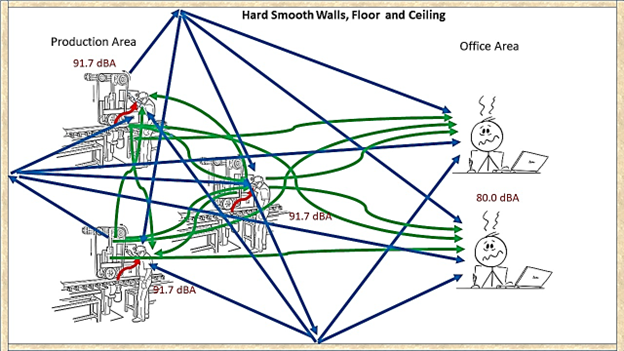
In this example, a production area is located in the same large room as are offices. Three production machines are shown on the left, each operated by a single person. The short RED arrows denote a ‘direct noise path’, which is emanating from a production machine directly to the operator (in close proximity) without any barrier between them. This is almost always the highest contributor to employee noise exposure, since there is very little physical distance between the noise source and the operator. If the machine hypothetically produces 90 dBA Time Weighted Average (TWA) when in operation, it is quite likely that the operator is being exposed to 90 dBA exposure levels as well.
The GREEN arrows indicate ‘indirect and/or distant noise paths’ which (in this case) exist: 1) between the machine operators and 2)across the plant to the office area. This situation is found in most industrial operations. These noise paths usually result in decreased noise contributions vs. the direct paths, since equipment and/or other structures may serve to ‘block’ some of the noise emanating from each machine and there may be considerable distances involved. In this case, if we assume that the machines are spaced about 20 feet apart, each adjoining operator may experience an exposure increase of noise on the order of 81 to 83dBA, simply due to the noise coming from each adjoining machine (not including the machine they are operating). Therefore, the effects of these indirect paths must be added to the overall noise exposure levels of each machine operator. In this three-machine simplified case, each operator would now be exposed to 90dBA + 83 dBA + 83 dBA = 91.5 dBA.
The BLUE arrows indicate ‘reflected noise paths’ which are due to sound waves bouncing off the floor, walls and ceiling of the room itself, and are being redirected to everyone in the facility. The amount of reflection is determined by the distance between the noise sources and surrounding room surfaces, as well as the acoustic characteristics of these surfaces. There are often a nearly infinite number of possible reflection paths, but only a few are shown here for simplification. We have hypothetically assumed that the total noise in the office area due to noise reflection and distant/indirect noise paths totals 80 dBA, which is still considered unacceptable. Note that the reflected noise also serves to add to the machine operators’ total exposure level, but only by a very small amount. This is due to the fact that the primary noise exposure level of the operators is dominated by the machine they are running combined with the noise from adjoining machines. If we hypothetically add 80 dBA of reflective noise content to the 91.5 dBA noise that the operators are already experiencing, this adds less than 0.2 dBA to their total noise exposure. This results in a 91.7 dBA exposure level to the operators. Controlling reflection(reverberation) is therefore not a critical factor in reducing operator noise exposure in this situation.
Some customers may take noise readings at various locations around the plant, and draw the conclusion that the main noise exposure problem is due to noise reflection from hard surfaces within the building. This is a common assumption, because the entire plant seems ‘loud’, even in the office areas. But direct noise paths almost always ‘dominate’ reflected noise levels around high-noise equipment.
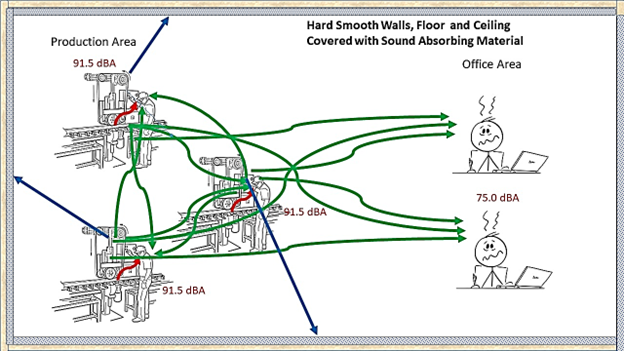
Reflections can be significant in the propagation of ambient noise at a distance from the machines. Reflections often contribute to the ‘din’ and high ambient noise readings far away from the machines. Sound reflection can be reduced by the use of noise absorbing materials covering a majority of these hard surfaces as shown in Figure 2. Sound waves striking these walls are now absorbed. This will certainly reduce the noise being reflected around the plant and into the office areas, but the overall results may be less than expected, since we still have strong direct and indirect noise paths present from the machinery. These wall treatments would make a very minimal difference to the machine operators, who are still being exposed to the direct and indirect noise paths in their immediate area. It may decrease their noise exposure by a few tenths of a decibel, but will make very little difference. Plus the office workers are still being exposed to higher than desired noise levels (now estimated at 75 dBA) due to the indirect and/or distant noise paths.
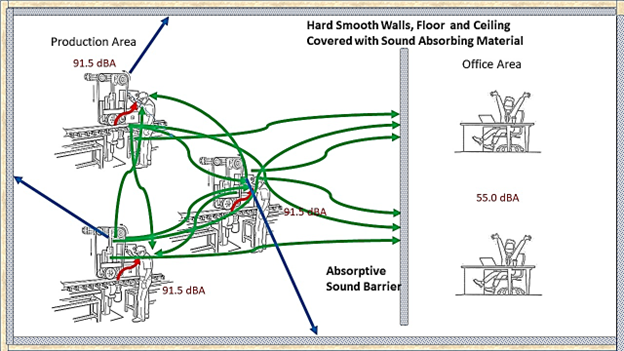
If we care only about the office area, the next step would be to place acoustic barriers or walls between the equipment and the offices (as seen in Figure 3), which would serve to attenuate the distant noise paths, and in combination with the wall treatments will significantly reduce noise levels in the offices. The noise baffles serve to block sound paths from the equipment, as well as to absorb sound to prevent sound reflections back into the plant area. But this step has done virtually nothing to reduce noise exposure for the machine operators.
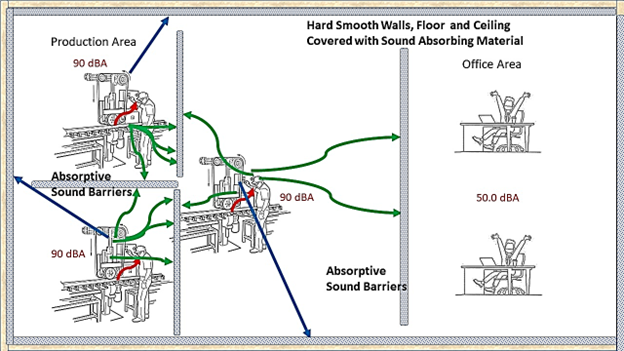
Another step that could be undertaken would be to place barriers around the machine operators, or to ‘compartmentalize’ their work spaces as seen in Figure 4. This approach will certainly reduce noise levels in nearby areas, but the fact that each operator is still is the direct noise path from each individual machine, his/her noise exposure level would be reduced by only 1.5 dBA, still resulting in a potential concern.
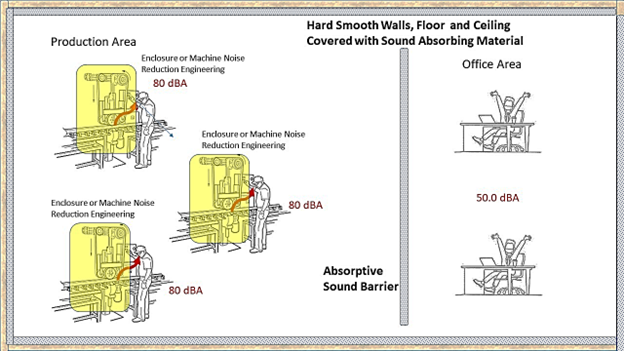
In situations such as these, the only viable alternatives are to either:
- Enclose the machines with an effective noise-blocking material such that the direct path of noise to the operator is reduced or eliminated. This can be a problematic process, as issues of part entry/exit from the machine, or difficulties with operational control may make enclosures impractical. In addition, good quality acoustic enclosures are often expensive and can make maintenance difficult. To be effective, enclosures must cover the vast majority of the machine’s surface area, as even very small gaps or holes will significantly reduce the sound attenuation capabilities of the enclosure.
- Implement design changes to the machinery such that noise sources are reduced, or that certain noisy components (only) are enclosed. These types of corrective actions can involve stiffening certain frame elements or rotating components, installation of low-noise drive belts or VFD motors, use of improved tooling, etc.
In any situation, it is critical that the customer determine the desired goals before a noise control study is undertaken. If the goal is simply to reduce noise in offices or surrounding areas (and the machine operators are consistently using hearing protection), then the first two noise correction steps noted above should suffice. If the intent is to reduce the noise exposure levels of the machine operators, then a much more comprehensive and design-focused effort must be taken to minimize noise at the source(s).
BASIC RULE OF THUMB: If the direct noise path to an operator isn’t blocked, or the if noise source levels aren’t reduced via engineered improvements, then other noise control measures are unlikely to have much effect on employee noise exposure when working in close proximity to the noise source.
There are instances, such as are often found with large presses, grinding operations or similar situations where high-force impacts or major metal removing operations are in use, it is usually not economically practical to reduce noise at the sources, and the use of hearing protection becomes the only viable solution.
Memtech Acoustics has the expertise to identify noise sources, analyze sound transmission paths, and develop cost-effective engineering solutions to address complex industrial noise challenges. Our integrated approach includes acoustic measurement, evaluation of sound propagation and reflection paths, development of targeted noise control strategies, and implementation of appropriate mitigation measures such as engineered materials or structural systems.
As a integrator, Memtech can manage the entire process, from initial assessment and diagnostic testing through system design, material procurement, and installation coordination. We also perform legally compliant noise monitoring and testing for employee noise exposure and environmental sound levels to support OSHA requirements, hearing conservation programs, and regulatory documentation.
Note: This represents a hypothetical but typical situation that occurs when dealing with industrial noise issues. It is meant to be a general example for educational purposes.