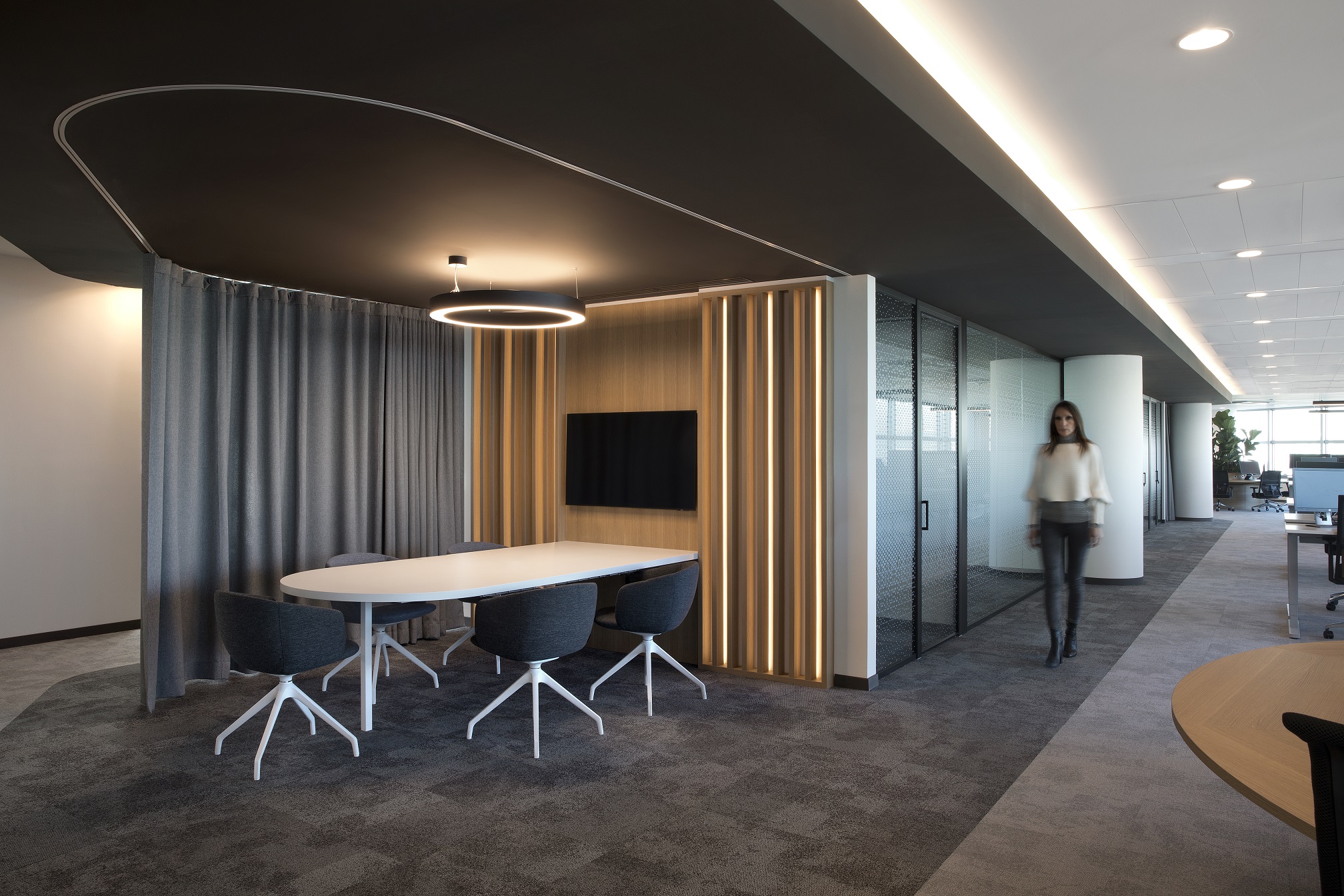
Flexible Sound Absorption in a Textile Form.
Acoustic curtain systems provide a visually integrated solution for controlling reverberation and improving acoustic comfort in open or highly reflective spaces. These systems utilize specialized acoustic textiles engineered with interwoven polyester fibers that interact with air to absorb sound energy, allowing designers to improve room acoustics where wall panels or ceiling treatments are not wanted.
The draperies we specify are laboratory‑tested, field‑proven drapery solutions designed to achieve both sound absorption (up to 1.0 NRC) and sound blocking (STC 13 or 17). Combining form and function, they offer elegant aesthetics with exceptional performance for residential and commercial applications.
The draperies we specify are laboratory‑tested, field‑proven drapery solutions designed to achieve both sound absorption (up to 1.0 NRC) and sound blocking (STC 13 or 17). Combining form and function, they offer elegant aesthetics with exceptional performance for residential and commercial applications.
These curtain systems are perfect for:
- Open-plan offices and collaborative workspaces
- Restaurants and hospitality interiors
- Conference rooms and training facilities
- Educational environments
- Residential living spaces
- Areas with large glass surfaces or reflective finishes
Six Reasons Acoustic Curtains Outperform Ordinary Drapes

Track & Trolley Hardware
Straight, curved, or multi-connector assemblies for any layout.

Multiple Mounting Options
Ceiling-hung, wall-mounted, or beam-suspended.

Performance Fabrics
Premium, fire-rated textiles including suede, velvet, and blackout linings; or integrate your own fabric choice.

Custom Fit & Finish
Designed to your exact size, fabric, and style, such as Ripplefold, pleated, flat panel, or Roman shades.

Acoustic Absorption
With NRC ratings up to 1.0, the draperies we specify can help reduce echo and reverberation, improving clarity and comfort.

Proven Noise Blocking
Optional STC 13 or STC 17 linings block part of the sound coming through a window or opening.

Acoustic Draperies
Curtain Types
Acoustic draperies come in two forms. Acoustic fiber textiles absorb sound through patented, inherently fire-resistant polyester fibers, so even lighter fabrics control echo. Lined acoustic draperies pair a heavy face fabric, pleated for fullness, with an optional sound-blocking lining rated STC 13 or STC 17. Both can hang on track as movable treatments or stay in place as permanent architectural elements.
These curtain systems are designed to help reduce reverberation and improve speech clarity, particularly in spaces with large glazing areas, hard finishes, or open layouts. By integrating acoustic performance directly into textile materials, acoustic curtains provide a solution that blends sound control, interior architecture, and sustainability.
These curtain systems are designed to help reduce reverberation and improve speech clarity, particularly in spaces with large glazing areas, hard finishes, or open layouts. By integrating acoustic performance directly into textile materials, acoustic curtains provide a solution that blends sound control, interior architecture, and sustainability.

Acoustic Draperies
Style & Fabric Options
The draperies we specify are designed to complement the aesthetics of your space while delivering outstanding acoustic performance. Each curtain is made with fire-rated, commercial-grade fabrics available in a variety of textures, weights, and finishes.
Performance & Design Highlights:
- Curtain Styles
Include pleated, ripplefold, flat, or roman and roller shades (STC 17 option) for tailored design. - Fabric Collections
Include premium suedes, velvets, cottons, and blackout linings, with fire-rated options in a wide palette. - Custom Fabric Program
For projects requiring specific textiles, Memtech Acoustics pairs client-supplied fabrics with the acoustic linings.

Acoustic Draperies
Lead Time & Logistics
Every drapery is custom-made to the specified size, fabric, and performance specifications.
Performance & Design Highlights:
- Typical Lead Time: 4–6 weeks from order to delivery.
- Installation Hardware: Heavy-duty Kirsch® traverse rods or ADC® tracks are recommended.
- Shipping & Delivery: Curtains are carefully packaged to prevent creasing and damage, arriving ready for installation.

Acoustic Draperies
Fire Ratings: ASTM E84 and NFPA 701
Drapery specifications usually call for one or both of two fire tests. They measure different things, so check which one your project requires.
What Each Test Means:
- ASTM E84 (UL 723)
A tunnel test that rates how far flame spreads across a material and how much smoke it produces. Class A is the highest of its three classes. - NFPA 701
The fire test for fabrics that hang vertically, such as curtains and draperies. Fire codes commonly reference it for draperies. - Acoustic Fiber Textiles
Pass NFPA 701 and are rated Class A under ASTM E84 and UL 723. - Lined Draperies
The sound-blocking linings are fire rated, and fire-retardant face fabrics that pass NFPA 701 are available.
Tell us the rating your specification or fire marshal requires, and we will match a fabric that carries it.

Acoustic Draperies
Sound Absorption by Fabric (NRC)
How much echo a drapery absorbs depends on the face fabric, how full it hangs and how far it sits from the wall. Independent laboratory tests (ASTM C423) of pleated draperies give these ranges:
Lab-Tested NRC by Face Fabric:
- Crescent Velour
NRC 0.85 to 1.0 - Vara Velvet
NRC 0.75 to 0.90 - Overture
NRC 0.65 to 0.80 - Nova Suede
NRC 0.50 to 0.65 - Solitaire
NRC 0.40 to 0.65
The lab hung each drapery at 2.5 times fullness, 5 inches from the wall. Less fabric or a tighter hang lowers the result. Acoustic fiber textiles are tested to ISO 354 instead of NRC; we send the absorption curve for the fabric you choose.

Acoustic Draperies
Retractable Acoustic Curtains on Track or Rod
Acoustic draperies can be fixed in place or retractable, drawing open and closed like a standard curtain. That suits rooms that need daylight or a view part of the day and echo control the rest.
Hardware & Operation:
- Track or Rod
Heavy-duty traverse rods or curtain track, sized for the weight of a lined drapery. - Mounting
Ceiling-hung, wall-mounted or beam-suspended. - Layouts
Straight, curved or multi-connector track runs. - Styles
Ripplefold, pleated and flat panels draw to one or both sides; Roman and roller shades raise and lower. - Plan for the Open Position
Ratings are measured with the drapery closed. Drawn back, the stacked fabric covers less area, so size the treatment for how the room is used.
Send the width and height of each opening and the mounting surface, and we will recommend the track or rod.
Performance Specifications
Download the full spec sheet below.
Noise Blocking (STC Ratings)
Optional linings rated STC 17, or a lighter STC 13, block part of the sound passing through a window or opening. Both rate well below a wall.
Sound Absorption (NRC Ratings)
Lab-tested pleated draperies range from NRC 0.40 to 1.0 depending on face fabric, fullness and distance from the wall. Fabric and hanging method can also target specific frequency ranges.
Integrated Acoustic Fiber Technology
Specialized polyester fiber structures interact with air to absorb sound energy and reduce reverberation.
Size & Coverage
Custom-built to your requirements, the draperies we specify are available up to 9ft tall with unlimited widths.
Additional Benefits
These draperies also provide blackout light control, thermal insulation, and compatibility with heavy-duty track systems, so draperies can be retractable, drawing open and closed as needed.
Sustainable Material Composition
Acoustic fiber textiles are 100% recyclable and GREENGUARD Gold certified, and can contribute to LEED v4 credits.
Fire-Rated Performance
Acoustic fiber textiles pass NFPA 701 and are rated ASTM E84 and UL 723 Class A. Lined draperies use fire-rated linings, with NFPA 701 face fabrics available.
Flexible Acoustic Installation Options
Curtains can be installed as window treatments, room dividers, sliding partitions, or suspended drapery systems.
Technical Data &
Product Literature
Can't find what you need?
Contact Us or call us at (248) 289-1123 during our normal business hours (Mon-Fri, 8:00AM to 5:00PM ET) to speak directly with a noise control expert.
STC 13 Lining Test
Lab Test Results
STC 17 Lining Test
Lab Test Results
Nova Suede French Pleat: NRC 0.55
Lab Test Results
Nova Suede Double Sided: NRC 0.60
Lab Test Results
Solitaire French Pleat: NRC 0.45
Lab Test Results
Crescent Velour Pleat: NRC 0.90
Lab Test Results
Overture Pleat: NRC 0.75
Lab Test Results

Why Memtech Acoustics’ Sourced Approach Excels
Most companies that sell “soundproof curtains” rely on generic imports with unverified claims. They may absorb a small amount of acoustic energy, but rarely deliver measurable results. At Memtech Acoustics, we take an engineered approach that ensures you get more than just fabric, you get proven acoustic performance.
What Sets Us Apart:
- Verified Performance Ratings
Fabrics and linings carry independent laboratory test reports for sound absorption and sound blocking (STC). - Customized to Your Space
The curtains we specify are sized, layered, and styled for your specific project, ensuring a tailored solution that works as designed. - Designed for Compliance
Fire-rated fabrics suit schools, hospitals and government facilities where a fire rating is required. We match the fabric to the test your code calls for. - Expert Consultation
As acoustic consultants, we help specify the right performance level, fabric type, and installation hardware. - Premium Craftsmanship
Handcrafted with precision stitching and reinforced construction, these curtains are built to last.

Support Beyond the Product
Installation Assistance
We assist in specifying track or rod hardware to support heavy-duty drapery.
Expert Support
Support available for fabric selection, hardware recommendations, and acoustic performance validation.
Custom Sizing
STC 13/17 options up to 9′ tall.
Premium Craftsmanship
Reinforced stitching and robust construction ensure durability.
Frequently Asked Questions (FAQs)
What are acoustic curtains used for?
Acoustic curtains are designed to reduce reverberation and improve speech clarity in spaces with reflective surfaces such as glass, concrete, or drywall. They are commonly used in offices, restaurants, meeting rooms, and other commercial interiors.
How do acoustic curtains absorb sound?
Acoustic curtains use specialized textile fibers that interact with air pressure to absorb sound energy. When sound waves pass through the fabric, the fibers dissipate acoustic energy, turning it into heat.
Are acoustic curtains as effective as wall panels?
Acoustic curtains are typically used to supplement wall or ceiling treatments, but they are not intended to be the primary method of noise control. When properly specified, they can noticeably improve reverberation control in spaces with large windows or open layouts.
Can acoustic curtains be used like standard curtains?
Yes. Many acoustic curtain systems are installed on track systems, allowing them to function like traditional curtains while also providing acoustic absorption.
Where are acoustic curtain systems most effective?
These systems work particularly well in spaces that include large glass surfaces, open floor plans, or minimal wall treatment, where traditional acoustic panels may not be practical.
Can acoustic curtains help improve speech privacy?
Acoustic curtains primarily reduce reverberation, which improves speech clarity. When combined with other acoustic treatments, they can also support improved speech privacy.
Are acoustic draperies fire rated to ASTM E84?
Yes. The acoustic fiber textiles we supply are rated Class A under ASTM E84 and UL 723 and pass NFPA 701. For lined draperies, the sound-blocking linings are fire rated, and fire-retardant face fabrics that pass NFPA 701 are available. Confirm which test your specification calls for, because fire codes often reference NFPA 701 for draperies.
What is the difference between ASTM E84 and NFPA 701?
ASTM E84 is a tunnel test that rates how far flame spreads across a material and how much smoke it produces; Class A is the highest rating. NFPA 701 tests how fabric that hangs vertically, such as a curtain or drapery, burns when exposed to flame. Many drapery specifications ask for NFPA 701, and some ask for both.
How much sound do acoustic draperies absorb?
Lab-tested pleated draperies range from NRC 0.40 to 1.0 depending on the face fabric. Velours sit at the top of that range and suedes lower. Fullness and the gap behind the curtain matter as much as the fabric, so we specify both.
Can acoustic draperies be retractable?
Yes. Acoustic draperies can draw open and closed on a heavy-duty rod or track mounted to the ceiling, wall or a beam. Ripplefold, pleated and flat panel styles stack to the side, and Roman and roller shades raise and lower.
Do acoustic draperies block sound between rooms?
Only partly. A drapery mainly absorbs echo inside a room. Linings rated STC 13 or STC 17 block some of the sound passing through an opening, but they rate far below a wall or a sound-rated door. To block sound through a window or doorway, see Quiet Curtains™.
What do you need to quote acoustic draperies?
The width and height of each window or opening, and how the drapery will mount (ceiling, wall or beam, on a rod or track). Tell us whether it should open and close, the fire rating your project requires, and a preferred fabric or color.
Let’s Engineer the Right Solution, Together.

Let's Get Started. Contact Us.
Talk to our experts. We’ll assess your needs and recommend a solution that works for your project.