Definitions you need to know, and questions you need to ask before hiring one
It can be hard enough to define what a consultant does before you even begin to add the word ‘Acoustic’ to the title. The irony is that while many people may be familiar with business and IT consultants, it’s acoustic consultants that can help companies avoid productivity drops of up to 66% (a performance impact that even the most high-profile business consultant can only dream about).
In this article, we'll look at what an acoustic consultant does, the questions you should ask before hiring one, and how companies like Memtech Acoustics can help.
Key takeaways
- Acoustic consultants are specialized scientific advisors who manage sound environments to maintain regulatory compliance and optimize human well-being in architectural, environmental, and industrial projects.
- The key distinction that separates acoustic consultants from engineers is that consultants apply acoustic science to the built environment and regulatory compliance, while engineers focus on the design and performance of specific systems and devices.
- To be qualified, a consultant requires not only an advanced degree but also years of verifiable, post-graduate professional experience, often benchmarked by certification bodies like INCE and the IoA.
- Acoustic consultancy fees are often results-driven, meaning fixed-fee arrangements are frequently preferred over hourly billing for key regulatory deliverables to provide clients with cost certainty.
What is an acoustic consultant?
An acoustic consultant is a scientific advisor and problem-solver who operates at the crossroads of physics, engineering, and architecture. They advise on the “invisible element” of design and construction-sound-making sure spaces function correctly, regulations are met, and occupants thrive.
Their role is to manage sound environments in various settings from reducing noise pollution in industrial zones to optimizing sound clarity in concert halls. If you’re involved in a project that involves any noise source, any key listening space, or any interaction with the surrounding community, hiring an acoustic consultant is an important step in due diligence.
What can an acoustic consultant help with?
The services provided by an acoustic consultant span three major areas - architectural, environmental, and industrial - all aimed at diagnosing, predicting, and controlling sound and vibration.
Architectural and building acoustics: In the architectural space, a consultant’s primary function is to optimize the internal acoustic environment to suit the structure’s purpose. They design soundproofing solutions to control noise from internal systems (like MEP components), and conduct essential measurements such as reverberation time assessments.
Environmental and mitigation strategies: Acting as the primary regulatory advisor, they conduct Noise Impact Assessments and comprehensive noise surveys to evaluate how new industrial facilities or transport hubs will impact the surrounding community, and advise on necessary mitigation strategies.
Compliance and legal documentation: A consultant makes sure a project complies with all local noise ordinances and national standards, providing the necessary technical reports and calculations to secure compliance and prevent project delays or litigation. In the event of legal action, they also act as expert witnesses.
What’s the difference between an acoustic engineer and a consultant?
While the terms are often used interchangeably, a distinction exists in their primary focus.
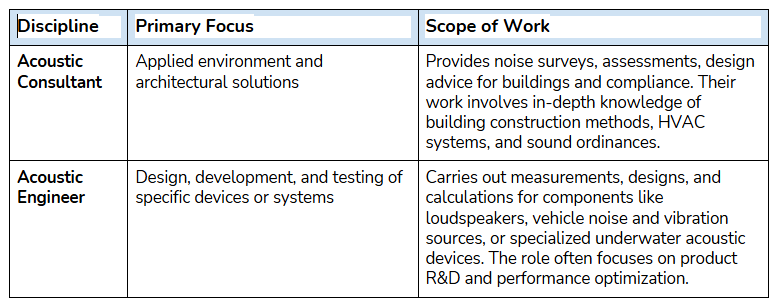
The most significant area of overlap occurs in environmental acoustics. While both engineers and consultants measure and predict noise levels, it’s the consultant who assumes responsibility for determining the acceptable level of that noise, formulating the ultimate mitigation strategy, and delivering community compliance.
What do you need to be an acoustic consultant?
Becoming a qualified acoustic consultant isn’t easy. Given the high-stakes nature of the work (where mistakes can lead to lawsuits), candidates need a combination of academic foundation, specialized training, and verifiable professional experience.
The path typically begins with a foundational degree in a scientific or technical discipline, such as physics, math, or engineering, which is often supplemented by postgraduate degrees (Master’s or PhD) in applied acoustics.
Professional certification is the ultimate benchmark in the US, verified by organizations like the Institute of Noise Control Engineering (INCE) in North America. INCE requires major post-graduate professional experience, underlining the importance of practical application. For instance, a candidate with a Bachelor of Science (BS) in Engineering and a Master's (MS) in acoustical engineering needs a minimum of four years, while those with a BS in a foundational science may require eight years for certification.
How much does an acoustic consultant cost?
The investment required for acoustical consulting services varies based on scope, complexity, and seniority. Clients tend to encounter two main structures: hourly rates for ongoing support and fixed project fees for defined deliverables (which offer cost certainty and focus on successful regulatory outcomes).
In the US market, standard consulting and measurement rates often hover around the $100 per hour mark. Fixed fees are common for initial assessments, ranging from $250 to $750 depending on the complexity of the site (e.g., home studio versus commercial space).
More comprehensive services tend to be structured as fixed fees also. A two-hour virtual consultation, including calculations, might cost in the region of USD $700.00, while a full engineering design package with acoustic modeling and 3D CAD documentation will start at around $2,750.
Whatever you end up investing in an acoustic consultant, chances are it’s going to be far less expensive for you than correcting acoustic failures later, and any legal fallout that might occur.
10 essential questions to ask before hiring
Hiring an acoustic consultant requires vetting that goes beyond simply checking credentials. You need to confirm their technical capacity, their experience in your particular field, and, just as importantly, their professional liability coverage. To give you a decent kick-start, here are the 10 most important questions you need to ask:
- What is your specific experience with projects identical or highly similar to mine?
A consultant for a manufacturing facility needs a different portfolio than one for a concert hall. - Which acoustic modeling and simulation software do you use, and what methods for sound measurement and analysis?
This confirms their reliance on modern, predictive tools and advanced, calibrated equipment for design, which minimizes guesswork and ensures adherence to recognized standards.
- How do you measure and evaluate the success of an acoustic improvement project?
Success should be defined by objective and quantifiable metrics, such as achieving a target Reverberation Time (RT60) or meeting a specific noise control standard.
- What is your knowledge of local noise ordinances and the national standards required for this project?
They must confirm familiarity with key regulatory standards relevant to your sector (e.g., OSHA, NIOSH).
- Describe your typical workflow and how you coordinate with the architectural and engineering design team.
The ideal response should demonstrate a proactive approach, including the cycle of documentation review, acoustical analyses, advising the design team, and coordinating implementation.
- What specific deliverables (reports, drawings, calculations) will I receive, and what standards will they adhere to?
You should receive definitive outputs, such as comprehensive Noise Impact Assessments, detailed acoustic calculation reports, and 3D CAD drawings specifying component placement.
- What is the Limit of Indemnity on your Professional Indemnity (PI) insurance policy?
The coverage limit must be appropriate for the scale and value of your project. If a claim exceeds their coverage, the liability can transfer back to you.
- What is the effective Retroactive Date for your PI policy?
This date determines how far back the policy covers liabilities. If the policy’s retroactive date post-dates the original work they performed for you, you’re going to be unprotected.
- Does your PI policy contain any specific exclusions (e.g., related to fire safety, pollution, or basements)?
You need to make sure that no exclusion exists for a service they are contracted to provide, which could inadvertently transfer full liability back to you.
- Are you or your firm members certified by a recognized professional body (e.g., IoA Chartered or INCE Board Certified)?
Formal certification is an external validation of professional expertise, experience, and commitment to industry standards.
How Memtech Acoustics can help?

At Memtech Acoustics, we serve as acoustic consultant partners, delivering fully integrated, data-driven solutions across industrial, commercial, and institutional sectors. Our engineering-first approach covers the entire project lifecycle, beginning with extensive data assessments, noise modeling, and vibration analysis to pinpoint root-cause issues.
We also move beyond consultation, managing tailored acoustic design that delivers regulatory compliance (including OSHA/NIOSH support), coordinating installation, and providing full project management.
Whether you’re building a gym, concert hall, office space, or factory, we’ll keep things nice and quiet for you, both environmentally and legally. Get in touch with the Memtech Acoustics team and get the acoustic expertise your project needs.