Engineered Noise Control Systems for Industrial & Commercial Facilities
From individual machines to entire facilities, we design and install effective noise abatement systems that solve complex acoustic challenges, without interrupting your operations.

A System Is More Than an Acoustic Panel
Effective noise control isn’t about hanging drapes, sticking foam on the walls, or buying a generic “soundproofing” kit. Real results come from understanding how sound travels through your facility, from the sources that generate it, through the structures that transmit it, and into the environments where people meet, work and relax.
At Memtech Acoustics, we design integrated noise abatement systems that go far beyond the specification of single products. Our approach combines acoustic analysis, predictive modeling, and field-proven engineered components to build solutions that:
At Memtech Acoustics, we design integrated noise abatement systems that go far beyond the specification of single products. Our approach combines acoustic analysis, predictive modeling, and field-proven engineered components to build solutions that:
- Reduce noise at its source, along its path, or at the receiver.
- Ensure OSHA, NIOSH, and industry compliance.
- Extend equipment life through vibration and acoustic control.
- Improve productivity and safety with quieter facilities.
- Deliver measurable, verifiable results.
- Fit seamlessly into your workflow.
This is system-engineered noise control. Modeled, designed, and built around your operation. For acoustics inside occupied buildings, like reverberation, speech privacy, and room-to-room isolation, see Architectural Design & Support. For acoustic oversight while an approved design is built, see Construction Administration.
Source-Path-Receiver: The Engineering Framework
Every noise problem has three components. Memtech Acoustics engineers interventions at each stage to deliver the most effective and cost-efficient solution.
Source
The machine, equipment, or process that generates the noise. Addressing the source is the most effective intervention in the hierarchy of controls.
Acoustic enclosures for machines, presses, and compressors
Vibration isolation mounts and pads
Damping treatments and equipment modifications
Path
The route noise takes from source to receiver, including air, structural elements, ductwork, and piping. Memtech Acoustics uses Acoustic Transfer Function (ATF) measurement to map how energy moves along that path and pinpoint the dominant route before specifying a fix.
Barrier walls and sound curtains
Silencers, duct lining, and mufflers
Structural isolation and absorptive wall/ceiling treatments
Receiver
The worker, neighbor, or sensitive equipment that experiences the noise.
Operator cabins and control room isolation
Hearing conservation programs and HPD selection
Administrative scheduling and rotation controls
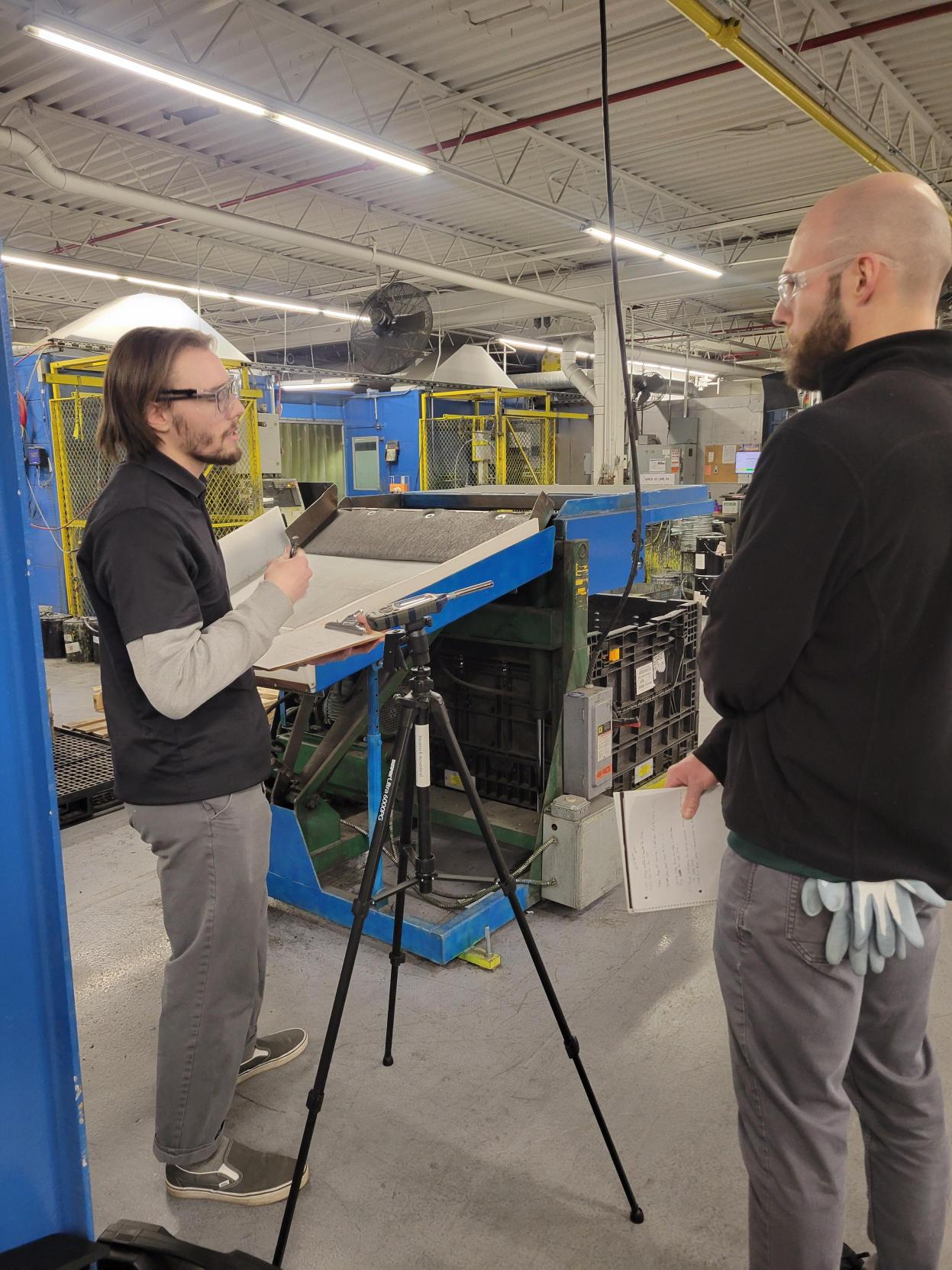
Engineered noise CONTROL SYSTEMS
Selecting the Right Control for the Noise Mechanism
Memtech Acoustics classifies every problem by its physical mechanism before naming a product. Most failed treatments put the right product on the wrong mechanism: absorption bought for a transmission problem, or an enclosure bought for a structure-borne one.
Measurements are taken at production load, at fixed positions, with background levels recorded with the source off. Each control is then sized from the data its mechanism requires.
Measurements are taken at production load, at fixed positions, with background levels recorded with the source off. Each control is then sized from the data its mechanism requires.
How each mechanism is handled:
- Reflection and reverberation
Sound reflects off hard surfaces and lingers in the space. Absorption is sized from RT60 measured in each octave band. - Airborne mechanical noise
Fans, compressors, chillers, and process equipment. Enclosures, barriers, silencers, and duct lining are sized by insertion loss in each octave band, with narrowband (FFT) analysis when the noise is tonal. Absorption alone does not control mechanical noise. - Structure-borne vibration
Energy carried through frames, floors, and foundations, often felt before it is heard. Isolators are selected by the machine’s disturbing frequency and load, confirmed with accelerometer data. An enclosure alone does not address it. - Transmission between spaces
Sound passing through a wall, floor, door, or window. The fix is mass, decoupling, and complete sealing, starting with the weakest element, usually a door or window. - Exterior propagation
Noise reaching a property line or a neighbor. Barrier walls, enclosures, and silencers are checked with a barrier calculation in each octave band. Low-frequency sources need height and mass. - Environment checks
Heat and ventilation, moisture, maintenance access, piping and electrical runs, and whether an enclosure physically fits, all reviewed before the design is final.

Engineered noise CONTROL SYSTEMS
Our Approach & Capabilities
Memtech provides turnkey noise abatement systems for industrial and commercial environments.
We integrate our solutions with facility layouts and production requirements to ensure noise control never compromises workflow or safety. With design & install delivery, we manage engineering, sourcing, and installation, followed by validation testing to prove performance.
Our capabilities include designing rigid and modular machine enclosures, custom barrier walls, and silencers for fans and ducts, as well as implementing vibration isolation systems and absorptive treatments to control reverberation.
We integrate our solutions with facility layouts and production requirements to ensure noise control never compromises workflow or safety. With design & install delivery, we manage engineering, sourcing, and installation, followed by validation testing to prove performance.
Our approach:
- Noise Mapping & Measurement
Identify dominant noise sources using professional multi-channel instrumentation. - Predictive Modeling
Acoustic modeling simulates noise and vibration behavior in facilities, construction sites, or mechanical systems. - Engineering Recommendations
Cost-effective solutions, including enclosures, barriers, isolation, or absorptive treatments. - Design & Install Execution
Deliver turnkey systems that integrate seamlessly into your facility without disrupting operations. - Validation & Documentation
Conduct post-installation performance validation and provide compliance-ready reports for regulators and EHS teams.
Credentials, Standards, and Engineering Depth
Facility engineers and EH&S managers validate noise control partners against credentials, standards compliance, and engineering depth.
Engineering Credentials
In-house acoustic engineering for complex acoustic modeling and formal engineering reports.
50+ years combined engineering experience
25+ years of practice (founded 2001)
2,000+ projects nationwide
20+ acoustic manufacturer partners (vendor-neutral)
Professional Memberships
Minority Business Enterprise (MBE) Certified. CAGE Code 1ART8. UEI CMBVSSJNN7U5.
Acoustical Society of America (ASA)
Institute of Noise Control Engineering (INCE-USA)
AIA Michigan
Construction Association of Michigan (CAM)
Standards and Methods
Source-path-receiver analysis with predictive acoustic modeling, vibro-acoustic engineering, and field validation.
OSHA 29 CFR 1910.95 and NIOSH REL
ANSI S12.19-1996, ASTM E336, E90, E1007, C423, E84
ASTM E84 Class A fire rating on absorptive and isolation materials
Modal testing, octave band analysis, noise mapping

Types of Engineered Noise Solutions
A true noise abatement system is a coordinated set of requirement definitions, supporting data, modeling, and material specifications that work together to reduce airborne sound, structure-borne vibration, or environmental noise.
Operator Cabins & Control Rooms
Noise-isolated workspaces that keep staff safe and productive in high-noise facilities.
Custom System Integration
Hybrid approaches blending enclosures, barriers, and absorption for complex environments.
These components are strategically selected and configured using acoustic modeling to ensure optimal performance.
How Every Project Runs
From Requirement to Verified Result
Memtech Acoustics runs every engineering project on the same model. The left side defines the result: what the problem is, what the space or equipment must measure once it is fixed, and how the design gets there. The right side proves it. Each check on the way up is measured against a decision made on the way down.
An engineered noise control system runs the whole model: measured source data, an engineered design, supply and installation, and a validation test against the target.
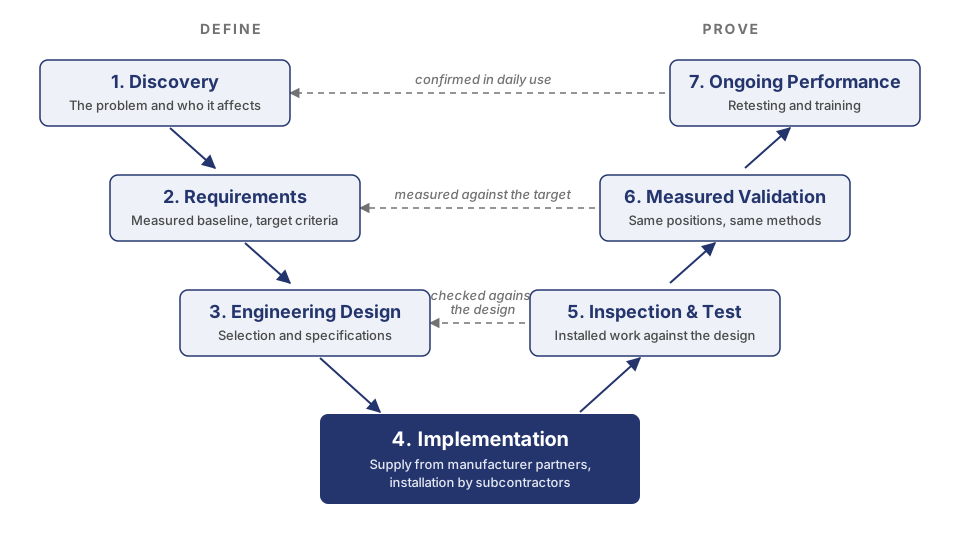
1. Discovery: the problem and who it affects.
2. Requirements: a measured baseline and the target criteria.
3. Engineering design: treatment selection and specifications.
4. Implementation: supply from manufacturer partners, installation by subcontractors.
5. Inspection and test: installed work checked against the design.
6. Measured validation: same positions and methods, measured against the target.
7. Ongoing performance: retesting and training as operations change.
Some engagements cover one part of the model, such as a test or a design review. The model shows where that part fits, and what comes before and after it.
- Checked against the design: inspection and testing confirm the installed work matches the specified assemblies and details.
- Measured against the target: validation repeats the baseline measurement at the same positions with the same methods, and compares the result with the requirement.
- Confirmed in daily use: retesting and training keep the result in place as operations change.
Our Process
From Analysis to Installation
2
System Design & Acoustic Modeling
Using frequency analysis and 3D noise mapping, we design a solution that targets the real source and predicts the real results.
4
Installation and Validation
Qualified subcontractors install the system under Memtech Acoustics project management, scheduled to limit disruption to your operation.
1
Site Assessment and Noise Survey
We begin by understanding your environment: what’s making noise, how it spreads, and where it causes problems.
3
Material Specification and Fabrication
We source or build system components that match your space, industry, and performance needs.
5
Post-Installation Testing and Reporting
We validate performance with follow-up testing and provide documentation for OSHA, municipal, or internal compliance.
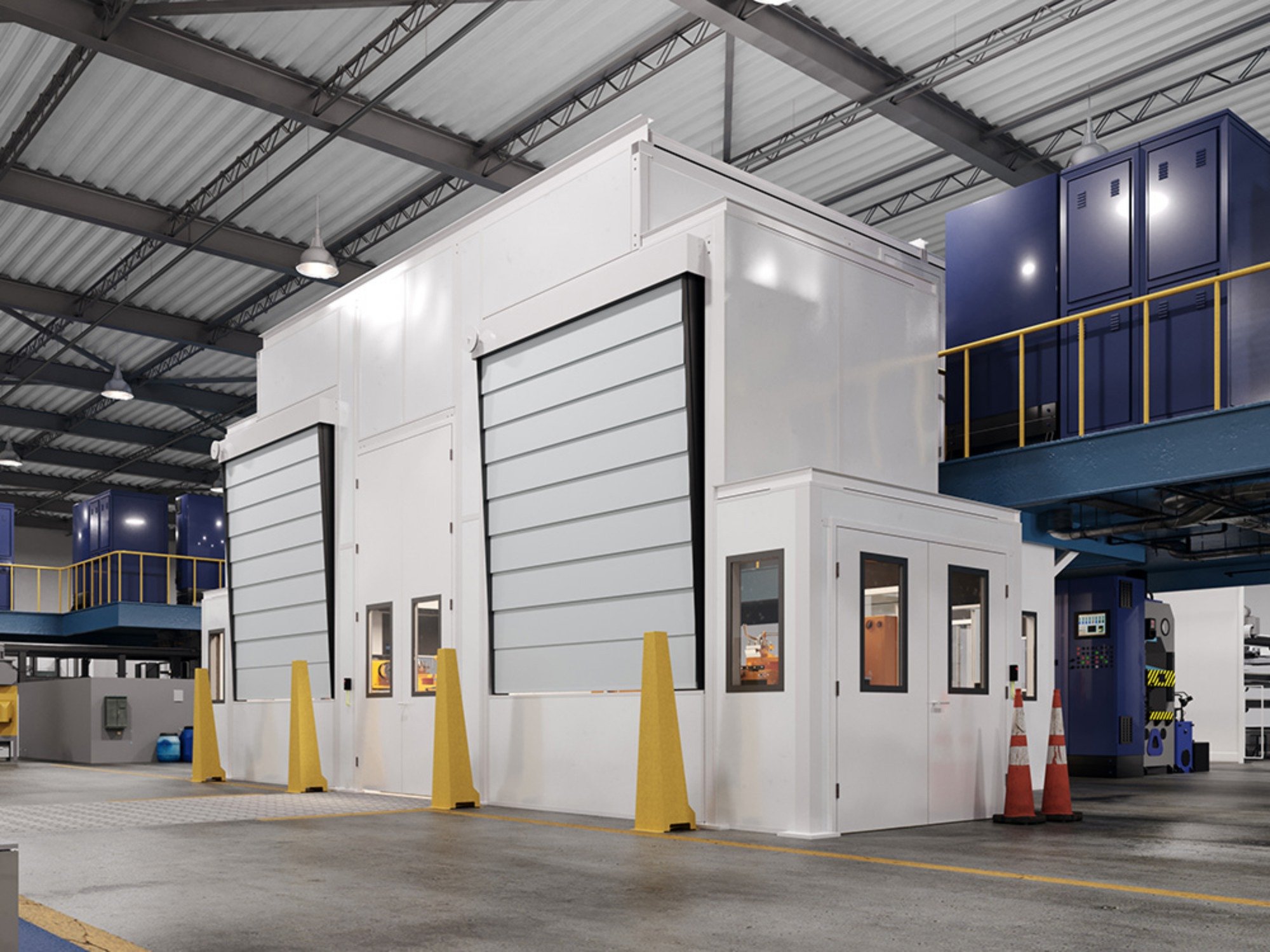
Featured Case Study
Compressor Noise Test Chamber Upgrade
Michigan Automotive Compressor, Inc. (MACI) needed its compressor noise test chamber to meet a new specification for ambient noise, vibration, and low-frequency performance. Memtech Acoustics measured the chamber, traced the problem to four separate causes, and engineered a fix for each one. Validation testing confirmed the chamber met every element of the specification.
Highlights
- Four causes found: high ambient noise, floor vibration reaching the test stand, test stand resonance, and drive system noise
- Added mass and a new absorptive lining on the walls and ceiling, a sealed drive shaft pass-through, and a concrete-filled test stand
- Validation testing found the stand's front face had not bonded to its core; a bonded steel plate stiffened it before the August 2021 retest
- Measured 27.7 dBA with the drive off, under the 30 dBA requirement, and 38.2 dBA with the drive at 3,000 RPM without a compressor belt, under the 40 dBA requirement
Key Applications

Manufacturing & Fabrication Plants
Control noise from process machinery, HVAC systems, support systems, and heavy equipment.

Warehouses & Distribution Centers
Reduce conveyor, inventory management and mechanical noise.

Energy & Utilities
Noise control for generators, turbines, substations, and pumping facilities.

Food & Beverage Processing
Control processing and packaging noise while maintaining hygienic conditions.

Transportation & Infrastructure
Specify and install rail, aviation, and roadway noise barriers.

Commercial Facilities
Noise management for HVAC systems, chillers, and other mechanical equipment.

Engineered noise CONTROL SYSTEMS
What You Receive
Memtech Acoustics gives you documents to review before anything is built, and measured data to check after it is installed. The scope sets which of these you receive, from a single diagnostic report to a full design, supply, and installation package.
Deliverables:
- Measurement and root-cause report
Operating and background levels by frequency band, vibration readings where a structure-borne path is suspected, and the mechanism driving the noise. Control options are ranked by feasibility and expected benefit, with realistic expectations for each. - Predictive model and options comparison
Predicted levels at the receiver for each option, so you can weigh cost against performance before construction. Where it helps, the model output is converted to audio so you can hear each option. - Design drawings
Panel construction drawings with dimensions, quantities, and tags, plus a layout drawing showing how the system assembles around the equipment. - Performance specifications
Materials described by STC, NRC, insertion loss, and fire rating, backed by the manufacturer’s data sheets and acoustic test reports. - Submittals for your approval
Submittal drawings to review before fabrication starts. - Installation coordination
Fabrication, foundations, and installation by qualified subcontractors under Memtech Acoustics project management. - Validation report
The same measurements at the same positions after installation, compared against the baseline and the design target.
Lead Time &
Project Delivery
Every system is custom-designed and built-to-order, ensuring performance and compliance.
- Assessment
Acoustic analysis and engineering design. - Design & Fabrication
Systems built to spec using proven materials and methods. - Installation
Turnkey or partnered installation services. - Validation
Onsite validation to confirm system performance. - Timeline
Typical projects range from 4–12 weeks depending on complexity.

The Memtech Difference
At Memtech, noise is our business. Our engineers oversee every step, ensuring that each project is properly delivered, on-time and within budget. This integrated approach delivers predictable results and protects your investment.

Certified Acoustic Professionals
Testing conducted by certified engineers and acoustic specialists, not general contractors or “safety consultants.”

National Standards Alignment
We follow OSHA 1910.95, NIOSH criteria, and ANSI S12.19-1996 methods for noise exposure assessment. Measurements are conducted via ISO procedures or per academically accepted methods.

Engineering Expertise
Noise measurements, analysis, modeling and installation support are overseen by professionals who understand acoustic theory, as well as the implementation of practical solutions.
High Responsiveness, Proven Reliability
We are your trusted local partner providing on-demand support and dependable project execution. Michigan-based with regional reach and national* shipping capabilities.

Confidential & Detailed Reporting
We don’t just submit a report. You are provided with complete documentation, delivered in easy-to-understand language with accurate data and comprehensive drawings.
*Shipping available across the continental USA, and international; installations are offered in select regions.
NOTE: We do not stock custom products in our U.S. warehouse. Ask us about lead times for your project.
NOTE: We do not stock custom products in our U.S. warehouse. Ask us about lead times for your project.

Engineered noise CONTROL SYSTEMS
When an Engineered System Is Not the Right Fix
An engineered system is the right answer when a specific source or path has to be controlled to a measured target. Memtech Acoustics will point you to a different first step when the problem calls for one.
Where to start instead:
- You need to document worker exposure
Start with Noise Exposure Testing. Full-shift dosimetry shows who is over the OSHA action level before you decide what to control. - The room itself is too reverberant
For echo and speech clarity in occupied rooms, start with RT60 & C50 Testing. - Sound is passing between rooms
An Acoustic Transfer Function Assessment finds the weak path in a wall, door, or ceiling. - The floor or structure is vibrating
Vibration Analysis identifies the disturbing frequency before isolators are selected. - Engineering controls cannot reach the target
Some large machines cannot be brought to the target by engineering controls alone. Memtech Acoustics says so early and pairs the controls with a Hearing Conservation Program.
Frequently Asked Questions (FAQs)
What is the difference between an engineered noise abatement system and standalone acoustic products?
An engineered noise abatement system integrates multiple components, including enclosures, barriers, absorptive treatments, and vibration isolation, into a coordinated design modeled for the specific facility. Standalone products address a single surface or symptom. Memtech Acoustics engineers complete systems using predictive modeling and source-path-receiver analysis to achieve maximum noise reduction at the lowest total cost.
How does Memtech Acoustics determine what type of noise control system a facility needs?
Memtech Acoustics begins with on-site measurement and analysis of airborne and structure-borne noise using multi-channel instrumentation. Predictive acoustic modeling identifies the most effective interventions at the source, along the transmission path, and at the receiver before recommending a system. This data-driven approach ensures the solution targets the root cause, not just the symptoms.
Can engineered noise solutions be retrofitted into existing facilities?
Yes. Memtech Acoustics frequently retrofits noise control systems into active industrial and commercial facilities. Installations are planned and phased to minimize downtime and production disruption. Retrofit projects follow the same engineering process as new construction: measurement, modeling, design, installation, and post-installation validation.
What industries benefit most from engineered noise abatement systems?
Manufacturing, automotive, aerospace, energy and utilities, food and beverage processing, warehousing, and logistics are the most common sectors. Memtech Acoustics also serves commercial facilities with HVAC noise, mechanical room noise, or reverberant open areas. The approach scales from single-machine enclosures to facility-wide noise control programs.
How long do engineered noise control systems last?
Depending on the design and materials specified, noise control systems typically deliver 20 to 40+ years of performance with minimal maintenance. Memtech Acoustics specifies all absorptive and isolation materials to meet ASTM E84 Class A fire rating, ensuring durability and code compliance throughout the system life.
How does Memtech Acoustics verify that a noise solution actually works?
Most of Memtech Acoustics' projects include post-installation validation testing. Engineers return to the facility after installation to measure sound levels, compare results against the engineered targets, and document compliance with OSHA, NIOSH, or project-specific criteria. Validation reports are delivered in compliance-ready format for EHS teams, regulators, and insurers.
What is source-path-receiver analysis and why does it matter?
Source-path-receiver (SPR) analysis is the engineering framework for understanding how noise travels. The source generates the noise (machine, equipment), the path transmits it (air, structure, ductwork), and the receiver experiences it (worker, neighbor, sensitive equipment). Memtech Acoustics uses SPR analysis to determine where intervention is most effective, whether at the source, along the path, or at the receiver, so the solution targets the root cause.
Can Memtech Acoustics work with our existing contractors and engineers?
Yes. Memtech Acoustics coordinates directly with general contractors, MEP engineers, and facility maintenance teams. On design-phase projects, Memtech Acoustics provides specifications and engineering drawings that integrate into the construction workflow. On retrofit projects, Memtech Acoustics manages installation through qualified subcontractors under Memtech Acoustics' direction.
Does Memtech Acoustics provide noise control for outdoor environments?
Yes. Memtech Acoustics designs and installs outdoor noise barriers, equipment screening, and perimeter sound walls for generators, substations, cooling towers, loading docks, and other external sources, engineered to meet local noise ordinances and community standards. On a Fairfax County data center, acoustic modeling and on-site sound mapping cut community noise by 18 percent, reduced levels about 20 dB at 73 Hz, and validated a 300-foot generator setback that eliminated penalty-level exposure.
What is mechanical noise control?
Mechanical noise control reduces noise from fans, compressors, pumps, chillers, generators, and process equipment. Memtech Acoustics measures the equipment’s frequency content first, then controls the noise at the source or along its path with enclosures, barriers, silencers, duct lining, or vibration isolation. Absorptive panels on the room’s surfaces alone do not control mechanical noise, because they leave the direct path from the machine unchanged.
What does custom noise control engineering include?
Custom noise control engineering from Memtech Acoustics covers measurement and root-cause analysis, predictive modeling of the options, design drawings and performance specifications, material supply, installation through qualified subcontractors, and a validation retest after installation. You can stop after the report or after the design, or carry the project through to a validated installation.
How much attenuation can an acoustic enclosure or barrier provide?
It depends on the noise’s frequency content, the materials, and above all the openings. Gaps, access doors, and ventilation openings usually set the real-world result, and low frequencies bend around barriers more than high frequencies do. Memtech Acoustics sizes enclosures and barriers by insertion loss in each octave band, predicts the result before fabrication, and measures it after installation.
What information does Memtech Acoustics need to start?
Provide floor plans or equipment drawings, photos of the equipment and the space, the machine type and its operating cycle or speed, and any ordinance, citation, or prior noise report. Notes on access, piping, ductwork, and lighting around the equipment also help. With that, Memtech Acoustics can scope the site visit and the measurements the problem needs.
Let’s Engineer the Right Solution, Together.

Let's Get Started. Contact Us.
Talk to our experts. We’ll assess your needs and recommend a solution that works for your project.