Challenge
Phoenix Sky Harbor International Airport is the fifth busiest airport in the United States, with approximately 192,000 passengers and guests passing through its doors every day. Terminal 4 houses eight concourses across approximately 185,000 square feet. In an airport environment, the PA system conveys critical information constantly, and clear verbal communication is essential for passenger safety and wayfinding. The hard, reverberant surfaces typical of airport construction bounce sound around creating echo that makes verbal communication extremely difficult. The city of Phoenix set specific noise criteria for HVAC units and associated ductwork to ensure that background noise did not interfere with PA system intelligibility.
Keeping 192,000 daily passengers comfortable in Phoenix's extreme heat requires extensive HVAC systems and massive runs of ductwork throughout the terminals, each a potential source of background noise that could compromise the required noise criteria.
Solution
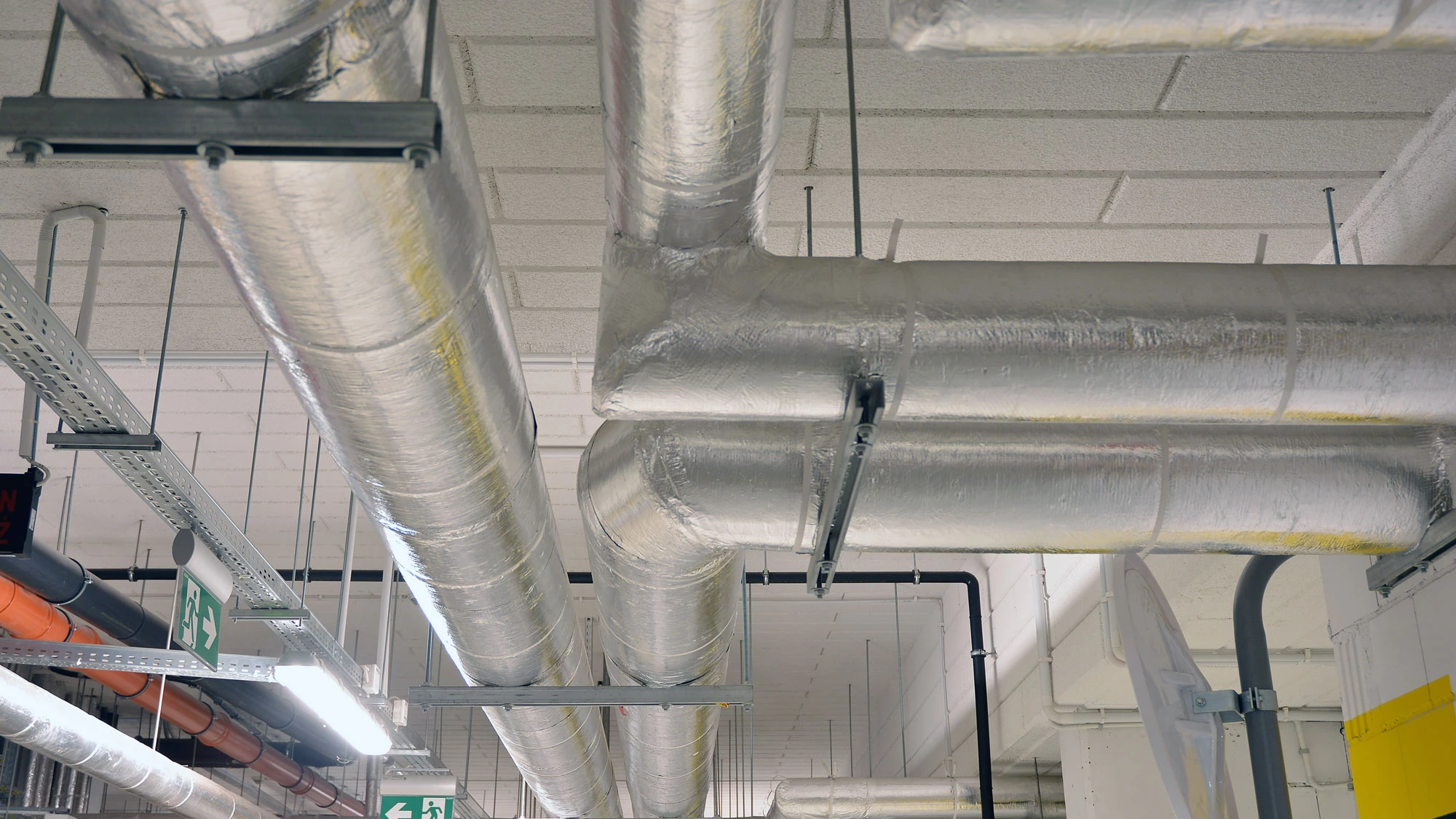
B-10 LAG/QFA-3 acoustical pipe and duct lagging material was specified for the terminal's ductwork. This composite consists of a one-pound-per-square-foot foil-faced barrier bonded to a one-inch-thick quilted fiberglass absorber. The product is specifically designed for wrapping the exterior of pipes and ducts to block noise that transmits through the duct walls as conditioned air moves through the system.
The foil facing allows for efficient installation using matching lag tape to seal horizontal and vertical seams, which was critical given the scale of the Terminal 4 ductwork runs. The fiberglass absorber/decoupler enables the flexible barrier to achieve optimum sound attenuation while also adding thermal insulation to the duct system. The B-10 LAG/QFA-3 achieves an STC 29 rating with sound transmission loss values ranging from 18 dB at 125 Hz to 46 dB at 4000 Hz.
The success of the lagging product in Terminal 3 had already been demonstrated, making the specification for Terminal 4 a proven choice. The local insulation contractor noted the product was as easy to install as any comparable material and had used it successfully on multiple other projects.
Results
The acoustical lagging met the city of Phoenix's background noise criteria for the HVAC system throughout Terminal 4, ensuring that PA system announcements remain intelligible across the concourse spaces. The combined acoustic and thermal performance of the lagging system addressed both noise control and energy efficiency in a single installation.