Challenge
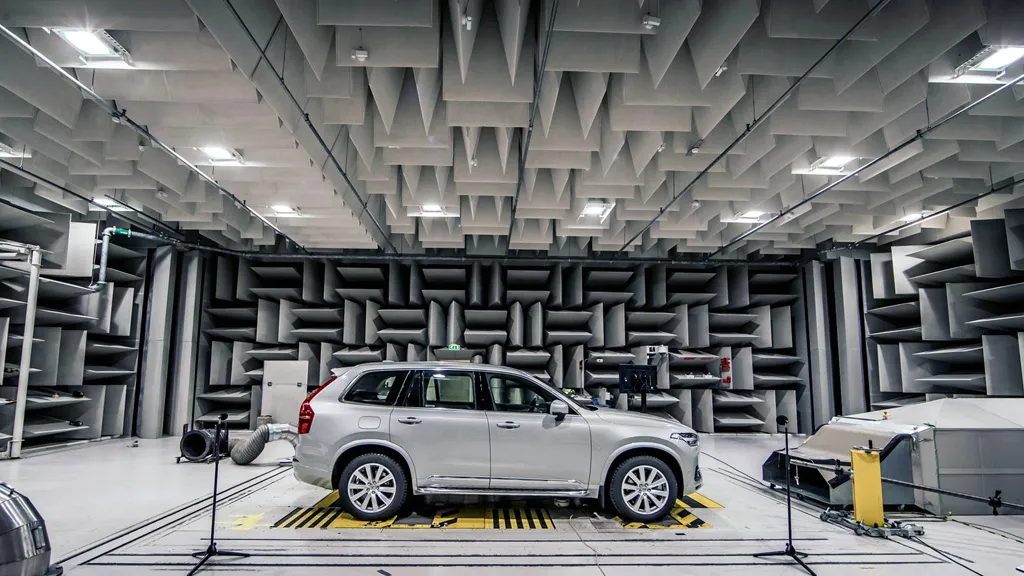
SoundOff Signal, a manufacturer of emergency vehicle lighting and warning systems based in Hudsonville, Michigan, required a qualified anechoic chamber for product testing to the SAE J1849 standard. This standard governs the acoustic output measurement of audible warning devices used on emergency vehicles, and testing must be performed in a calibrated free-field environment with verified frequency response characteristics.
The chamber needed to achieve a free-field tolerance of +/- 2.2 dB across a frequency range of 562 Hz to 14,100 Hz. The facility presented specific constraints: the chamber would be constructed in a below-grade room, which provided natural isolation from external noise but introduced structural challenges for wedge mounting and moisture management. The room geometry was intentionally non-parallel to reduce standing wave formation, a design feature that had to be preserved and enhanced by the acoustic treatment.
Solution
Memtech Acoustics designed and built the anechoic chamber from the ground up, engineering every element of the acoustic environment to meet the SAE J1849 free-field requirements.
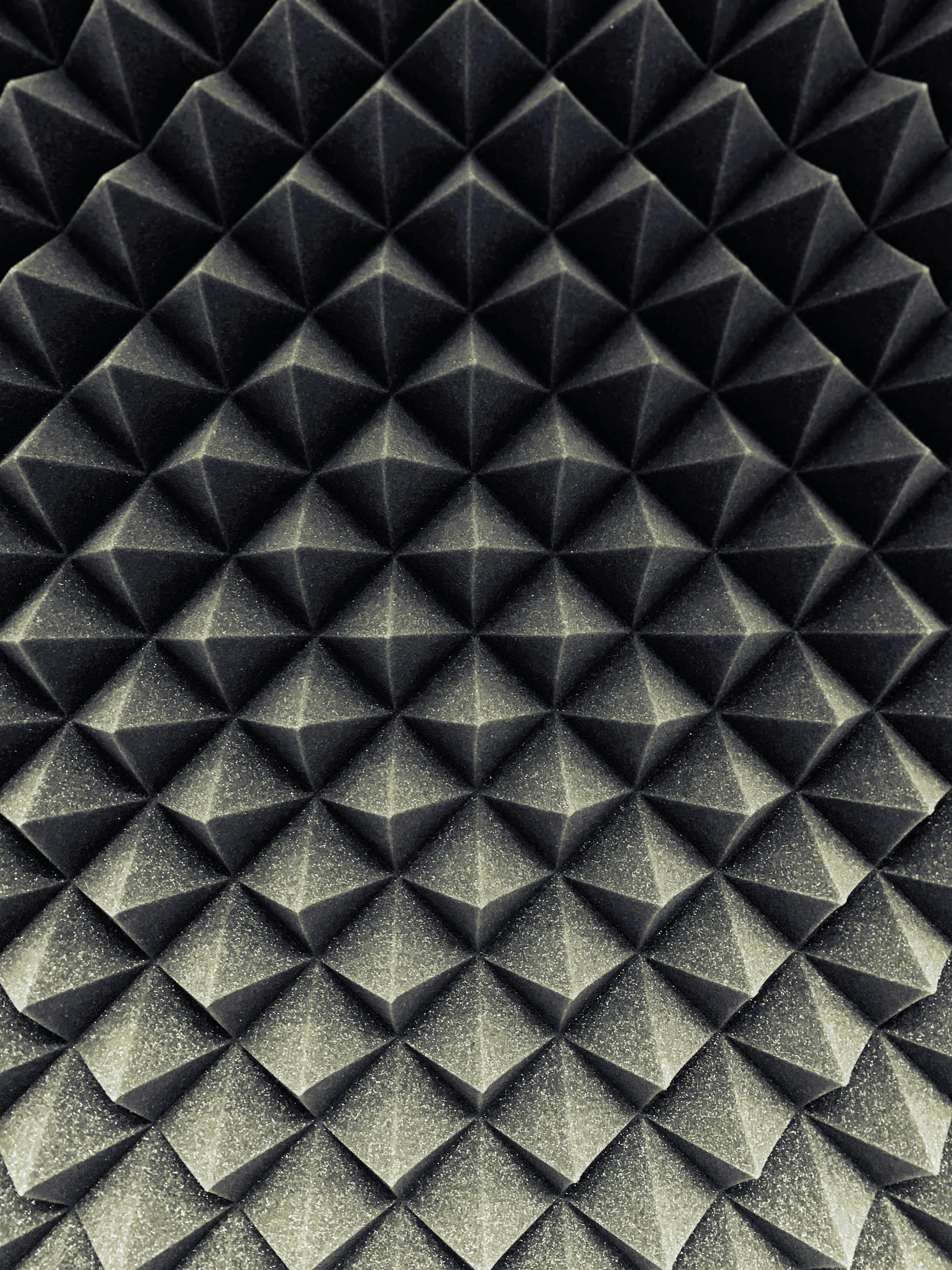
Wedge Treatment: The chamber interior was lined with pyramidal acoustic wedges, custom-sized and positioned to achieve the required absorption coefficient across the full test frequency range. The wedge geometry, depth, and material density were calculated based on the lowest frequency of interest (562 Hz) to ensure anechoic performance down to that threshold. Mineral wool was used as the primary absorptive medium for its consistent density, fire resistance, and long-term dimensional stability.
Room Geometry: The existing non-parallel wall geometry was leveraged in the wedge layout to further suppress standing waves and modal behavior. Wedge placement accounted for the room's asymmetric dimensions, ensuring uniform free-field conditions throughout the measurement volume.
Structural Integration: The below-grade construction required engineered mounting systems for the wedge panels that accounted for moisture resistance, structural load, and accessibility for future maintenance or recalibration. All mounting hardware and backing materials were specified for the below-grade environment.
Verification Protocol: Memtech developed and executed a comprehensive verification testing protocol, measuring the chamber's frequency response at multiple positions within the measurement volume to confirm that the +/- 2.2 dB tolerance was met across the entire 562 to 14,100 Hz range.
The project timeline ran from March to October 2021, covering design, fabrication, installation, and verification testing.
Results
The completed anechoic chamber met the SAE J1849 free-field tolerance of +/- 2.2 dB across the full 562 to 14,100 Hz frequency range at all measured positions within the test volume. SoundOff Signal gained an in-house testing capability that eliminated their dependence on external test facilities for SAE J1849 compliance measurements. The chamber's verified performance allows SoundOff Signal to conduct product development testing and compliance verification on their own schedule, reducing development cycle time and external testing costs. The below-grade construction and non-parallel geometry, combined with the engineered wedge system, produced a measurement environment that meets the precision requirements of the standard.