A Noise Risk Management Process for a Manufacturing Plant
It is challenging to develop a workable plan to reduce employee noise exposure levels in manufacturing plants; OSHA mandates strict limits on allowable exposure levels, and the costs associated with violations/penalties can have a profound impact on ‘the bottom line’. Noise exposure levels above 85 dBA TWA may trigger a requirement to develop a ‘Noise Action Plan’. If noise exposure exceeds 90 dBA TWA, an ‘Action Plan’ becomes an absolute necessity. The plan must address the implementation of specific processes or improvements that will result in measurable reductions in noise exposure levels. Given all the variables that potentially impact noise exposure, managers can become quickly overwhelmed in developing an ‘Action Plan’ that is affordable, practical, and will be acceptable to OSHA. Failure to do so often results in significant fines and other penalties.
In facilities with high-noise machinery (i.e. stamping or broaching operations), with older equipment, or where groups of loud equipment are co-located in large, reverberant areas, it may seem nearly impossible to implement a viable noise mitigation plan. However, by developing an incremental strategy combining the use of acoustic materials, logistic changes in work patterns and the deployment of improved hearing protection and employee monitoring plans will often be acceptable for OSHA’s ‘Noise Action Plan’ requirements.
Several key points are often overlooked when devising a plan:
- OSHA’s noise exposure requirements are solely related to the noise ‘dose’ that employees receive over the workday. Dose is not necessarily correlated to the ambient noise levels in the plant. Ambient levels are the averaged sound pressure levels at a specific location over a predetermined time period. Exposure levels represent the total noise that an employee experiences during the entire work shift. It is true that, for a plant which has consistent ambient noise levels below 85 dBA at all locations, the employee 8-hour noise dose cannot exceed the 85 dBA ‘action level’ (or 100% dose). But even in situations where some portions of the plant exceed ambient levels of 85 dBA, it is common for employee noise exposure levels to be well below the 85 dBA threshold. Time spent far away from loud equipment and during breaks will act as ‘credits’ toward reducing overall daily noise exposure levels. Given all the variables that exist in a manufacturing plant, is impossible to ‘guess’ at noise exposure levels; they must be measured and evaluated on the employees. A certified noise survey must first be undertaken to document ambient levels and employee noise exposure levels during a typical workday before an ‘Action Plan’ can be developed.
- By balancing worker locations throughout a shift, it may be possible to reduce noise exposure levels by limiting work times in areas of high noise. For example, moving a press operator to a quieter location for part of the day can significantly reduce average noise exposure levels. This can even be accomplished within departments, as a high degree of variance in ambient noise levels can be present in different areas.
- By identifying and targeting noise sources in a prioritized manner, incremental improvements can be made. If the ambient noise in a given department measures 92 dBA, the predominance of noise energy may due to contributions from only a few machines. If one piece of equipment measures 90 dBA (with all other noise sources turned off), reducing this noise by only 3-4 dBA can have a significant impact on both ambient noise and noise exposure levels. Attempting to achieve a 10 dBA noise reduction on an older machine may be unaffordable; but simply addressing a subsystem in the machine (e.g. a hydraulic pump) can make a significant impact on overall noise.
- In some instances, installing lightweight acoustic walls or dividers can isolate noise within a department; in this manner, high noise on one side of the divider will be isolated, meaning that many employees in the department will now benefit from a lower noise exposure level.
- The use of improved hearing protection devices may be advisable. While foam earplugs can work well, they can fit poorly or become uncomfortable. Fitted hearing protection is more costly, but when they result in reducing noise exposure during the workday, it becomes a ‘win-win’ for both employees and management.
Bear in mind that the goal of an Action Plan is to develop a practical noise action plan that will result in less noise exposure. Noise Action Plans are not required to reduce current exposure levels to any predetermined level; they are intended to improve existing conditions in a measurable way.
A Case Study
A noise exposure study was undertaken at an engine components plant, and it was determined that many employees had noise exposure levels well above 90 dBA. Figure 1 shows the results of the exposure study.
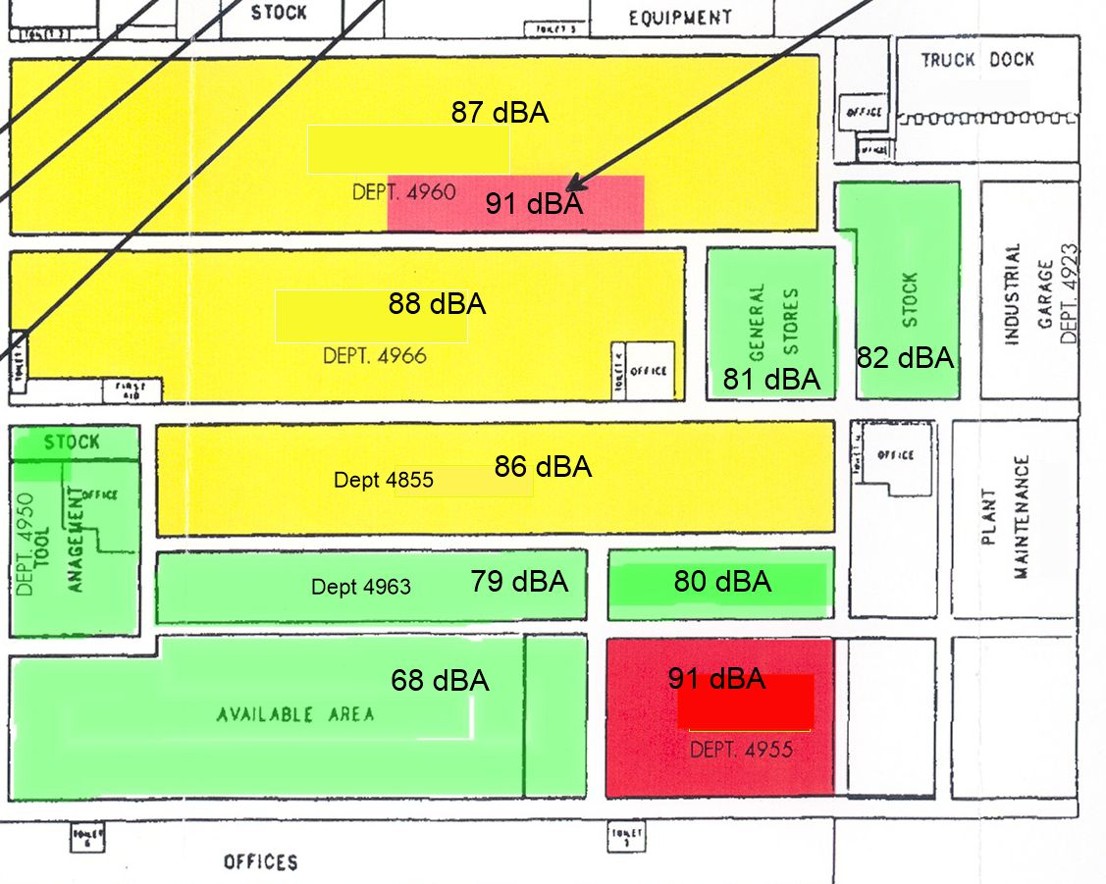
Management determined that the old stamping equipment in Dept. 4955 would be impossible to enclose or re-engineer. They were simply too large, and the need for operator access and part movement would prohibit the use of any type of noise-control barriers located between machines and workers. Since the high noise exposure levels in that department were due to having workers located directly in front of the machines (i.e. a direct noise path), use of noise of absorption materials on walls and ceilings (to reduce reverberation) would result in negligible improvements for employees operating the equipment. In other words, there was little that could be done to reduce noise in that department.
This required that logistical changes be made. Operators in Dept 4955 were rescheduled to work half the day in that location, and were moved to assembly operations in Dept 4963 for the remainder of the shift. Since the average noise exposure level in 4963 was only 79 dBA, when workers were ‘swapped’ between these two departments after lunch, all resultant exposure levels were reduced to less than 85 dBA.
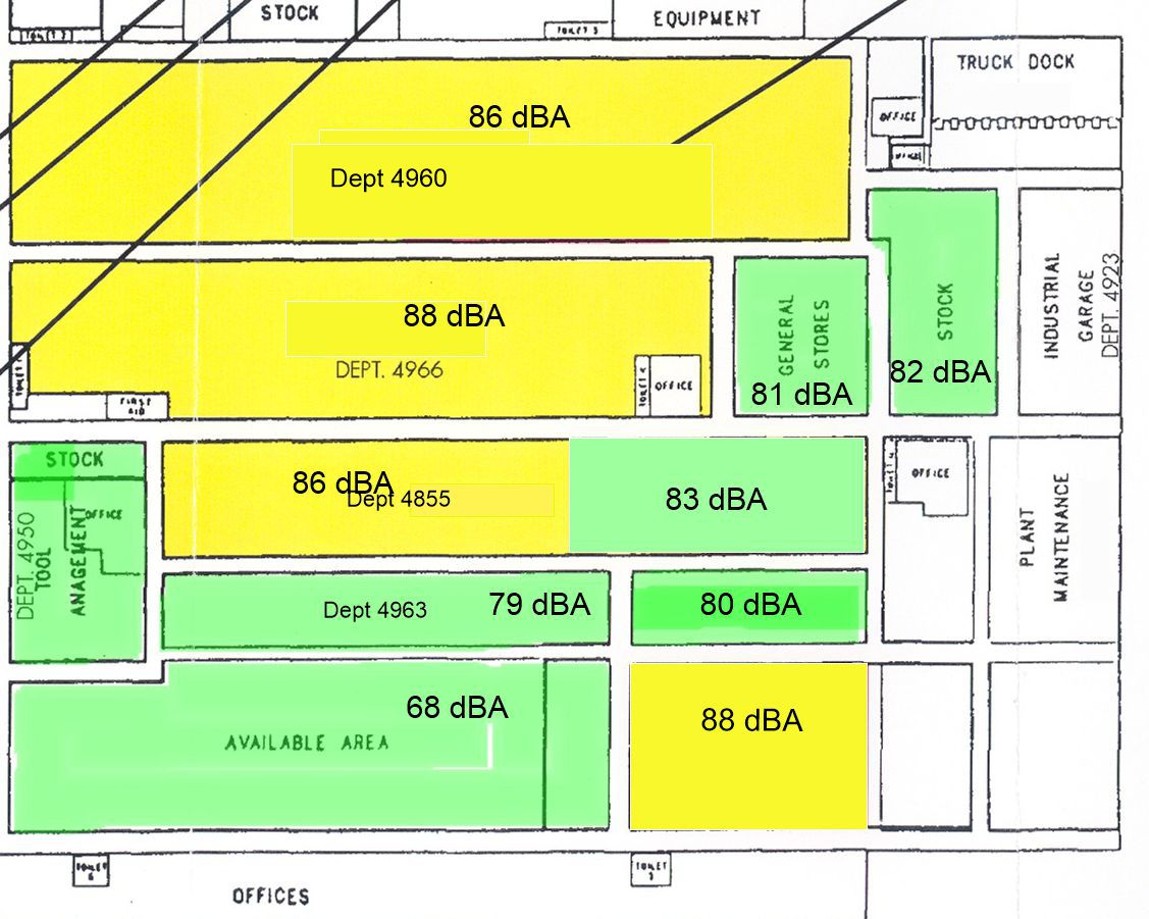
Large broaching equipment was in use in Department 4960. Again, this equipment was too large and complex to re-engineer for less noise. Noise enclosures would be unaffordable due to size. However, it was noted that two compressors in that area were each radiating over 90 dBA into the department, which resulted in ambient noise levels of 93 dBA in that localized space This noise also tended to radiate and reflect into nearby areas, adding to the overall ‘din’. The compressors were not large, and were good candidates for lightweight acoustic noise enclosures, using access doors for repairs were necessary. Use of the enclosures alone resulted in employee 8-hour noise exposure being reduced from 91 dBA to 88 dBA in that part of the department; a marked improvement which improved the ‘red’ area in the department to ‘yellow’. Not a perfect solution, but certainly an effective incremental improvement for a ‘Noise Action Plan’.
In Department 4855, it was found that a large parts washer and associated automation equipment generated noise far above 85 dBA, resulting in high noise exposures in that area. Through the implementation of a basic noise barrier wall (with doors) between the washer system and the rest of the department, noise exposure levels of less than 83 dBA were subsequently measured for many employees assigned to this department.
Finally, a plan to clearly mark all areas of the plant which have ambient noise levels above 85 dBA was undertaken. Clearly visible “Hearing Protection Required” signs were installed, and improved hearing protection devices (larger and more compliant foam plugs) were made available throughout the plant. These plugs were also placed in locker rooms and at all plant access points. Supervision was notified that hearing protection was now mandatory (strictly enforced) in those departments where exposure levels had been recorded above the 85 dBA limit.
The subsequent noise exposure study results are shown in Figure 2. While there are still ‘yellow’ areas with exposure levels above 85 dBA over the 8-hour work shift, red areas have been eliminated, and yellow areas have been reduced. This may seem like a modest improvement, but as far as OSHA is concerned, the plant has complied with a viable “Noise Action Plan” that has reduced the overall risk for employee hearing loss.
Of course, every plant situation is different. Union restrictions, production layouts, parts movement, HVAC requirements and a variety of other factors will drive the appropriate strategies. In some instances, simply prohibiting the use of ‘boom boxes’ (which will add to overall noise), or better enforcement of hearing protection devices can be effective elements of an overall ‘Action Plan’. The intent is not necessarily to move from a RED condition to a GREEN condition via a comprehensive re-engineering process, but rather to make incremental and measureable improvements in overall employee noise exposure levels.
MEMTECH ACOUSTICS has over 20 years experience in dealing with the creation of effective Noise ‘Action Plans’, and stands ready to work with your plant management and safety professionals to craft a workable strategy that is both affordable and practical.