
Our Role in Your Design Process
The Memtech Acoustics design assist process closes the gap between consulting, specification, and field coordination. We deliver acoustic modeling, engineered design, value engineering, and submittal review under one accountable team during preconstruction. When the design is approved and it is time to build, our Construction Administration service reviews submittals and substitutions, inspects the acoustic work, and verifies the result in the field.
We provide data-driven guidance to help design teams make informed choices for optimal acoustic results.
We provide data-driven guidance to help design teams make informed choices for optimal acoustic results.
Our experts evaluate and recommend:
- Wall, floor, and ceiling assemblies for sound isolation
- HVAC and mechanical system noise control systems
- Solutions for excessive room reverberation
- Vibration isolation for sensitive equipment and structures
- Mitigation measures for exterior noise problems
We can support your team from schematic design through field validation, or step in during retrofits to diagnose and correct existing noise challenges.
Common Challenges We Solve.

Open-plan office spaces with minimal speech privacy
Acoustic zoning, ceiling treatments, and sound masking design.

Floor-to-floor noise transfer in multi-story buildings
Optimized STC/IIC-rated assemblies and slab isolation detailing.

Excessive echo in gymnasiums, auditoriums and cafeterias
Noise absorbing materials and installation.

Mechanical vibration in occupied areas
Structural isolation, demising walls, and resilient mount recommendations.

Mixed-use developments with residential/commercial overlap
Façade sound insulation, acoustic and mechanical isolation systems.

Healthcare or lab facilities with strict noise criteria
Acoustic barrier design and specialized sound absorbing panels.

Design-ASSIST
Acoustic Materials Specification & Installation
Memtech supports architects, interior designers, and owners with acoustic design expertise that goes beyond specifying materials alone. Depending on the project, we may begin with an on-site acoustic assessment or analytical study to understand how sound behaves within the space and identify the most effective, cost-conscious design strategies.
For projects where requirements are already defined, Memtech can move directly into product specification, pricing, and installation support. Whether we are engaged early in design or later in the process, our role remains the same: to deliver acoustical solutions that are technically sound, architecturally compatible, and aligned with the project’s performance goals.
For projects where requirements are already defined, Memtech can move directly into product specification, pricing, and installation support. Whether we are engaged early in design or later in the process, our role remains the same: to deliver acoustical solutions that are technically sound, architecturally compatible, and aligned with the project’s performance goals.
Design-ASSIST
Why Acoustic Design-Assist Matters During Preconstruction
Fewer handoffs. Greater accountability. Proven results.
Traditional acoustic consulting often ends with drawings and recommendations, leaving clients to coordinate multiple vendors. The Memtech Acoustics design assist philosophy closes that gap.
By uniting engineering, product specification, and installation oversight, we streamline delivery, reduce the cost of change orders, and ensure that every detail functions exactly as intended.
Benefits include:
- Single point of accountability from design through installation
- Faster project delivery and fewer coordination errors
- Solutions tailored to actual field conditions
- Verified acoustic performance upon completion
Design-ASSIST
Our Approach & Capabilities
Acoustic considerations are often overlooked when rooms or buildings are designed and built, yet they impact everything from comfort and communication to compliance and client satisfaction.
Memtech Acoustics bridges that gap with a structured, engineering-first approach that blends science, field experience, and design collaboration. This page covers acoustics inside the built environment. For noise from machines or industrial processes, see Engineered Noise Control Systems. When an approved design needs to be built and verified, our Construction Administration service carries the acoustic design through the construction phase.
We work directly with architects, engineers, and general contractors to ensure that acoustic goals are defined, documented, and delivered within budget. Our methodology combines data-driven analysis with practical construction knowledge, ensuring solutions that are both technically sound and feasible within your budget and timeline.
Our core capabilities:
- Architectural Acoustics Consulting – Design support for walls, floors, ceilings, and interior finishes to optimize noise isolation and the desired acoustic characteristics.
- Mechanical Noise & Vibration Control – Solutions for HVAC, structure-borne vibration, and unwanted sounds emanating from nearby machinery.
- Room Acoustic Optimization – Modeling and treatment design for auditoriums, classrooms, and open offices.
- Code & Standards Compliance – Testing and documentation in accordance with IBC, ANSI, ASTM, ISO, LEED, and WELL guidelines.
- Retrofit & Remediation Design – Acoustic upgrades for existing facilities experiencing noise from adjoining areas or reverberation issues.

DESIGN-ASSIST
Applications
Our design-assist approach is scalable for both new construction and retrofit projects across multiple environments:

Design-ASSIST
Acoustic Solutions We Engineer and Specify
Fully integrated solutions that deliver measurable acoustic performance.
How Every Project Runs
From Requirement to Verified Result
Memtech Acoustics runs every engineering project on the same model. The left side defines the result: what the problem is, what the space or equipment must measure once it is fixed, and how the design gets there. The right side proves it. Each check on the way up is measured against a decision made on the way down.
Design-assist works the left side: it turns performance goals into targets and the assemblies the drawings carry.
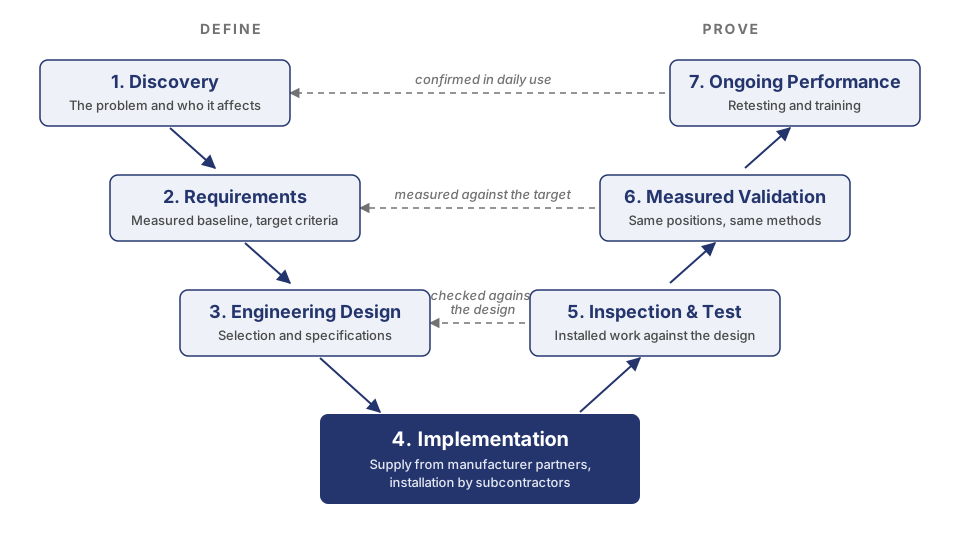
1. Discovery: the problem and who it affects.
2. Requirements: a measured baseline and the target criteria.
3. Engineering design: treatment selection and specifications.
4. Implementation: supply from manufacturer partners, installation by subcontractors.
5. Inspection and test: installed work checked against the design.
6. Measured validation: same positions and methods, measured against the target.
7. Ongoing performance: retesting and training as operations change.
Some engagements cover one part of the model, such as a test or a design review. The model shows where that part fits, and what comes before and after it.
- Checked against the design: inspection and testing confirm the installed work matches the specified assemblies and details.
- Measured against the target: validation repeats the baseline measurement at the same positions with the same methods, and compares the result with the requirement.
- Confirmed in daily use: retesting and training keep the result in place as operations change.
Design-ASSIST
Our Process
1
Discovery & Assessment
Our team reviews floor plans and mechanical layouts, along with customer needs and specifications to identify potential noise paths or design elements that could impact acoustic performance.
3
Design Integration & Coordination
We work hand-in-hand with your architectural, structural, and MEP teams to integrate acoustical elements seamlessly.
5
Construction Oversight & Quality Assurance
During the build phase, we perform technical reviews, site inspections, and in-field adjustments to ensure installation aligns with the acoustic design intent, and that costs remain within budget.
2
Acoustic Modeling & Simulation
We use advanced simulation tools to predict how sound will behave within and around your space. This allows us to understand acoustic behavior and to design cost-effective solutions long before construction begins.
4
Material & Assembly Specification
We prepare detailed specifications and Bill-Of-Material (BOM) lists for sound-rated walls, glazing, doors, and acoustic finishes, along with vibration control components.
6
Verification & Post-Occupancy Testing
Once construction is complete, we conduct field tests to confirm that the acoustic performance meets specifications.
Design-ASSIST
What You Receive
Memtech Acoustics delivers documents a design team can coordinate and build from. Each one ties to the project's phase, so acoustic decisions land in the drawings before construction documents are issued.
Depth follows the project. A tenant fit-out may need a drawing review and assembly notes. A performance space may need measurement, a model and drawings of a redesigned element.
Depth follows the project. A tenant fit-out may need a drawing review and assembly notes. A performance space may need measurement, a model and drawings of a redesigned element.
Design-assist deliverables:
- Acoustic targets: the performance each space must reach, such as RT60, STC, IIC and NC, set from the room's use and, where the space exists, from measured data.
- Drawing review: a review of the architectural set with marked-up plan views, grouping rooms by the separation or privacy each needs.
- Assembly recommendations: walls, doors, glazing and ceilings matched to each target, with flanking and penetration details at wall heads, plenums, doors and services.
- Acoustic notes and specifications: notes for the drawings and specification text for the project manual, with every absorptive and isolation material specified to ASTM E84 Class A.
- Modeling results and drawings: predicted performance against each target, and 2D CAD drawings where a room element needs design.
- Engineering report: findings and recommendations in plain language, followed by a review meeting with the design team.

Featured Case Study
Speech Privacy Planning for an Office Build-Out
A company fitting out offices and training space inside an existing single-story building in Plymouth, Michigan wanted speech privacy planned before the walls went up. The general contractor brought Memtech Acoustics in during design. Memtech Acoustics reviewed the architect's drawings, grouped the rooms by the privacy each needed, and specified the walls, doors, ceiling details and sealing.
Highlights
- Rooms grouped into privacy zones from the architectural set and the owner's marked-up drawings
- Executive suite estimated at STC 54 to 56 composite, a design value from laboratory ratings, not a field test
- Doors specified to match their walls: STC 50 for the executive suite, gasketed STC 35 for staff offices
- Weak links flagged before construction: doors, the ceiling plenum, open roof-deck flutes and penetrations

Value Engineering and Cost Management on the Acoustic Scope
Acoustic issues are rarely addressed until there’s a problem, and by then, correcting problems becomes expensive and disruptive. Designing it right the first time avoids costly retrofits, regulatory penalties, and user dissatisfaction.
Single Point of Accountability
Memtech manages every phase, from design and material procurement to installation and verification, ensuring consistent communication, clear ownership, and predictable results.
Streamlined Coordination
By consolidating consulting, product procurement, and installation under one team, we minimize change orders, delays, and the miscommunication that often happens between separate vendors.
Cost and Time Efficiency
Integrated planning reduces rework, accelerates timelines, and allows for smarter material sourcing, delivering measurable savings without compromising performance.
Verified Acoustic Performance
Every Memtech Acoustics design assist engagement concludes with on-site acoustic testing and documentation that confirm sound levels, reverberation, and vibration meet the engineered targets.
Tailored Engineering Solutions
Each solution is engineered through data acquisition, modeling and advanced analysis to achieve the best balance of acoustic performance, aesthetics, cost and durability.
Long-Term Reliability and Support
Design assist projects are executed with consideration of lifecycle cost and supported by the Memtech Acoustics continued technical support to ensure sustained performance long after project completion.
Credentials, Standards, and Specification Coverage
Architects and general contractors need to validate an acoustic partner against credentials, code references, and named standards before they hand over part of the project scope. Here is what Memtech Acoustics brings to a design team.
Acoustic Engineering & Modeling
Complex acoustic modeling and formal engineering reports delivered in-house.
25+ Years and 2,000+ Projects
Memtech Acoustics has practiced acoustic engineering since 2001 and completed over 2,000 projects nationwide. The team brings 50+ years of combined engineering experience.
Memberships and Certifications
AIA Michigan, Acoustical Society of America (ASA), Institute of Noise Control Engineering (INCE-USA), Construction Association of Michigan (CAM). Minority Business Enterprise (MBE) Certified. CAGE Code 1ART8. UEI CMBVSSJNN7U5.
CSI MasterFormat Specification Coverage
Specifications written across CSI sections 09 83 00, 09 84 00, 09 80 00, 09 51 00, 13 48 13, 13 48 23, 13 21 48, 23 05 48, and 23 33 19. All materials specified to ASTM E84 Class A fire rating.
Standards and Codes
OSHA 29 CFR 1910.95, NIOSH REL, ASTM E336, E90, E1007, C423, E84, ANSI S12 series, ANSI/ASA S12.60 (classroom acoustics), FGI Guidelines (healthcare), ICD 705 (SCIF construction), IBC, ISO 1996, 9613, 3745, LEED v4 and v4.1 EQ Acoustic Performance, and WELL acoustic criteria.
Advanced Acoustic Modeling
RT60, C50, STI, NC, STC, IIC, and OITC modeling. Acoustic Transfer Function (ATF) assessment to locate sound isolation problems and flanking paths between spaces. Statistical Energy Analysis (SEA). Finite Element Analysis (FEA). 3D reverberation modeling. Room modal analysis. Geometric modeling. All absorptive and isolation materials specified to ASTM E84 Class A fire rating.
Design-ASSIST
How Memtech Acoustics Selects Assemblies and Materials
Memtech Acoustics names the physical mechanism before it names a product. Most failed treatments are the right product applied to the wrong mechanism: absorption bought for a sound isolation problem, or an enclosure bought for a vibration problem.
Each selection starts with the data that mechanism needs, then a written target. The quantity and grade come from the calculation, and the product is chosen from more than 20 manufacturer partners without a preferred brand.
Each selection starts with the data that mechanism needs, then a written target. The quantity and grade come from the calculation, and the product is chosen from more than 20 manufacturer partners without a preferred brand.
The selection sequence:
- Classify the mechanism: reverberation inside a room, sound passing through a wall, floor, door or window, mechanical or structure-borne noise, or exterior noise reaching the building.
- Confirm the data: RT60 by octave band for reverberation, the existing assembly rating for isolation, octave-band or narrowband frequency content for mechanical noise. A single overall level is not enough.
- Set the target: the RT60, STC, IIC, NC or insertion loss the space must reach, written down before any product is chosen.
- Size the solution: absorption at the problem frequency bands, isolation by the target rating and the weakest element in the wall, barriers by insertion loss per octave band, isolators by the disturbing frequency and load.
- Check the environment: fire rating, moisture, impact, cleaning, mounting and appearance. A product that meets the acoustic target but fails the room is the wrong product.
- Record the reason: the mechanism, the data, the target and the choice, so the specification can be defended in review.
Standards behind the ratings, in addition to those listed above: ASTM E1332 (OITC), ASTM E492 (laboratory impact, IIC), ANSI/ASA S12.2 (NC and RC background noise) and ISO 3382-1 and -2 (RT60 and C50).
Our Design-Assist Process
- Assessment & Analysis
We begin by understanding your goals and gather baseline acoustic/vibration testing with state-of-the-art instrumentation. - Design and Engineering
Our engineers develop a detailed design using advanced modeling and simulations specific to your environment. - Product Specification & Procurement
We specify materials that meet performance, fire rating, and aesthetic requirements, partnering with trusted manufacturers to ensure consistency and quality. - Installation Coordination
Memtech manages installation through pre-qualified contractors, ensuring every component is installed per the design intent and verified for performance. - Validation, Documentation & Support
Post-installation measurements confirm that results meet design targets for sound isolation, reverberation time, and speech clarity. Deliverables include before/after performance data and installation documentation for your records.
Design-ASSIST
When Design-Assist Is Not the Right Service
Design-assist works best while the drawings can still change. Once the building exists, or when the noise has a different source, another Memtech Acoustics service usually fits the project better.
Consider these services instead:
- The room is built and too reverberant: RT60 & C50 Testing measures the room and sizes the treatment.
- Sound passes between existing rooms: an Acoustic Transfer Function assessment measures the isolation and finds the paths.
- The design is approved and construction is starting: Construction Administration reviews submittals, inspects the work and field-tests the result.
- You want one team to design, supply and coordinate the installation: Design & Install.
- The noise comes from machines or a process: Engineered Noise Control Systems.

The Memtech Difference
At Memtech, noise is our business. Our engineers oversee every step, ensuring that each project is properly delivered, on-time and within budget. This integrated approach delivers predictable results and protects your investment.

Certified Acoustic Professionals
Testing conducted by certified engineers and acoustic specialists, not general contractors or “safety consultants.”

National Standards Alignment
We follow OSHA 1910.95, NIOSH criteria, and ANSI S12.19-1996 methods for noise exposure assessment. Measurements are conducted via ISO procedures or per academically accepted methods.

Engineering Expertise
Noise measurements, analysis, modeling and installation support are overseen by professionals who understand acoustic theory, as well as the implementation of practical solutions.
High Responsiveness, Proven Reliability
We are your trusted local partner providing on-demand support and dependable project execution. Michigan-based with regional reach and national* shipping capabilities.

Confidential & Detailed Reporting
We don’t just submit a report. You are provided with complete documentation, delivered in easy-to-understand language with accurate data and comprehensive drawings.
*Shipping available across the continental USA, and international; installations are offered in select regions.
NOTE: We do not stock custom products in our U.S. warehouse. Ask us about lead times for your project.
NOTE: We do not stock custom products in our U.S. warehouse. Ask us about lead times for your project.
Frequently Asked Questions (FAQs)
How does acoustic design assist work on a construction project?
Memtech Acoustics joins the design team during schematic design or design development to model the acoustic environment, optimize STC, IIC, NC, and RT60 targets, write specifications, and coordinate with the architect, MEP, and structural teams. The design-assist process catches acoustic issues during SD and DD when the fix is a spec revision, not a change order. When a project needs the acoustic design carried through construction, our Construction Administration service extends through submittal review, field inspections, and post-construction validation.
When in a project should an architect or GC bring Memtech Acoustics in for acoustic design assist?
As early as schematic design. STC and IIC assembly choices, room geometries, mechanical equipment locations, and HVAC routing all drive whether the space will hit RT60, NC, and STI targets. These choices are dramatically cheaper to coordinate during SD and DD than to remediate after construction. Memtech Acoustics joins design teams in SD or early DD to model the acoustic environment and lock in the scope before construction documents are issued.
Does Memtech Acoustics provide value engineering and cost management on the acoustic scope?
Yes. Value engineering at Memtech Acoustics is measurement-led. Memtech Acoustics models the space first, identifies which assemblies actually drive the performance targets, and right-sizes the specification so the project pays for what it needs and skips what it does not. Because Memtech Acoustics specifies products from 20+ acoustic manufacturer partners, recommendations are vendor-neutral. The best-fit product for the application, not the one any single manufacturer happens to carry. Cost management continues through procurement coordination and submittal review during construction.
Does Memtech Acoustics provide construction-phase support during construction administration?
Yes. Memtech Acoustics delivers construction-phase support including submittal review, substitution evaluation, performance equivalency analysis, and interdisciplinary coordination with the architect, structural engineer, and MEP team. On projects where field conditions require verification, Memtech Acoustics performs on-site acoustic testing during construction to confirm assemblies are performing to the engineered targets before closeout.
Does Memtech Acoustics provide acoustic design assist for retrofits and renovations, or only new construction?
Both. Memtech Acoustics regularly delivers acoustic design assist for renovation, tenant improvement, and adaptive-reuse projects where existing field conditions and phased occupancy create constraints that do not exist in new construction. The preconstruction assessment uses on-site acoustic measurement to document baseline conditions, identify code-compliance gaps, and produce engineered solutions that work around active operations.
What types of buildings and projects does Memtech Acoustics provide acoustic design assist for?
Memtech Acoustics delivers acoustic design assist for commercial offices and tenant improvements, healthcare and life sciences facilities (FGI Guidelines), K-12 and higher education (ANSI/ASA S12.60), worship centers and performance venues, industrial and manufacturing facilities (OSHA 29 CFR 1910.95), data centers and AI infrastructure, energy and environmental projects, and government and institutional buildings, including ICD 705 SCIF construction with acoustic engineering oversight. Memtech Acoustics has completed 2,000+ projects nationwide in 25+ years of practice.
How does acoustic design assist actually save money on a construction project?
It moves acoustic decisions from change orders into design. The most expensive acoustic problem is one discovered after construction: a wall that does not meet STC, a generator that exceeds the local noise ordinance, a classroom that fails ANSI S12.60. The Memtech Acoustics measurement-led design-assist process catches those issues during SD and DD when the fix is a spec revision, not a tear-out. Combined with vendor-neutral product specification across 20+ manufacturer partners, the result is a right-sized acoustic scope that hits the performance targets without overspecifying.
Can Memtech Acoustics provide complex acoustic modeling and formal engineering reports?
Yes. Memtech Acoustics provides complex acoustic modeling and formal engineering reports for projects that require them. Combined with 50+ years of combined engineering experience and 25+ years of practice, this gives design teams direct access to experienced acoustic engineering without bringing in an outside consulting firm. Memtech Acoustics is a member of AIA Michigan, the Acoustical Society of America (ASA), the Institute of Noise Control Engineering (INCE-USA), and the Construction Association of Michigan (CAM).
Does Memtech Acoustics support LEED and WELL acoustic credits?
Yes. Memtech Acoustics supports LEED v4 and v4.1 EQ Acoustic Performance credits and WELL acoustic criteria as part of design-assist engagements. Documentation includes the acoustic modeling data, material specifications with performance ratings, and the post-construction field validation needed to demonstrate credit achievement.
Do I need a separate acoustic consultant, or can Memtech Acoustics fill that role?
Memtech Acoustics provides experienced acoustic engineering directly to design teams. For projects without a dedicated acoustic specialist, Memtech Acoustics delivers RT60, STI, NC, and STC modeling, Statistical Energy Analysis, Finite Element Analysis, HVAC noise studies, and field validation. On projects with a separate acoustic consultant of record, Memtech Acoustics executes the design-assist scope under that consultant's design intent: specification writing, submittal review, field coordination, and validation testing.
What does an architectural acoustics consultant deliver during design?
Documents the design team can build from. On a Memtech Acoustics design-assist project that usually means performance targets for each space, a review of the drawings with marked-up plans, recommendations for walls, doors, glazing and ceilings, flanking and penetration details, and acoustic notes or specification text for the drawing set. Where a room element needs design, Memtech Acoustics adds measurement, a model and 2D CAD drawings.
How does acoustic design coordinate with the MEP and structural engineers?
Through the same design phases. Memtech Acoustics coordinates partition ratings with the architectural and structural design, ceiling treatments with the MEP layout of diffusers, lighting and sprinklers, and mechanical noise and vibration isolation with the MEP equipment and the structural isolation details. Resolving these in schematic design and design development keeps them out of change orders.
Why does a wall measure lower in the field than its STC rating?
STC is measured on a laboratory sample. In the building, sound also travels around the wall through the plenum, doors, penetrations and structure, so the field rating usually reads lower. Memtech Acoustics designs with laboratory ratings and adds the details that protect the field result, because field performance typically runs 5 to 10 points below laboratory values.
How does Memtech Acoustics decide which acoustic product to specify?
By diagnosing the mechanism first. Memtech Acoustics classifies the problem as reverberation inside a room, sound passing through an assembly, mechanical or structure-borne noise, or exterior noise, because each needs a different fix. Absorption lowers reverberation but does not stop sound passing through a wall. The product is then sized to a written target and checked against fire rating, moisture, impact, cleaning and mounting needs.
Let’s Engineer the Right Solution, Together.

Let's Get Started. Contact Us.
Talk to our experts. We’ll assess your needs and recommend a solution that works for your project.