Whenever a newly proposed AI Data Center (or any other large-scale plant) hits the news, pushback will certainly occur from nearby residents. Many concerns can be raised; some may be legitimate, while others may simply be driven by rumours.
Noise is one of these concerns. Mainstream reports of ‘dangerous subsonic noise’ and ‘unbearable roar’ are common; however, in reality, many AI plants have come online with virtually no noise impact to surrounding areas. In other cases, objectionable noise is clearly present, which can be cause for complaints and litigation. Many cities, townships, and communities are ill-prepared for such a situation. One of the primary factors is the reliance on old (or non-existent) noise ordinances in the affected areas.
What is a Noise Ordinance?
A Noise Ordinance is a legal requirement that establishes acceptable noise limits for the area. It may be as simple as “nocturnal noise must not exceed 60 dBA at property boundaries”, or it may be a complex and detailed set of measurement processes and criteria based on zoning, time-of-day, and types of activities. Enforcement of these restrictions is often left to local police. Follow-up can be very inconsistent, depending on workload and assigned responsibilities within different organizations. Some complaints are acted upon immediately, while others are delayed or ignored completely; it is not uncommon for enforcement personnel to have no familiarity with noise measurement techniques or details of the ordinance requirements.
The Importance of Establishing Valid Limits
Surprisingly, many communities simply state “no noise shall be generated that is objectionable to neighbours”. Now think about that statement for a moment. How many times has a neighbour operated a leaf blower or played the stereo a bit too loud? Multiply that by the hundreds (or thousands) of residents in your community. Is it reasonable for police to investigate all these potentially ‘objectionable’ violations? And more importantly, when that new data center shows up in the field behind your house, who is to say that the noise is now ‘objectionable?’ Some neighbours may be unbothered, while it drives others crazy. The developer certainly won’t find it objectionable. These kinds of ‘subjective assessment’ noise cases show up in court all the time, but it becomes a complicated and expensive battle to determine what ‘objectionable’ really means per your community ordinance. Of course, severe and sustained sources of annoyance must be addressed (someone blasting their car radio all night), but care must be used in the wording such that a few minutes of operating a snow-blower does not justify a ‘legitimate’ call to the police department.
Even worse, how does a new plant developer/builder design a plant that won’t be ‘objectionable’ to anyone in the area? Some people will complain about noise long before any of the equipment is even operational, simply because they don’t like the plant being there in the first place. Developers and builders need solid, specific noise targets beforehand, so that they can design the plant’s equipment to be fully compliant.
In other cases, a noise limit may be stated in an ordinance, referencing only “A-Weighted” sound pressure readings. This metric has been in use for many years and does provide a reasonably good representation of the sound level as perceived by the human ear. Most measurement instruments have “A-Weight” capability, and it is easily measured by virtually anyone. However, it is not intended as an ‘annoyance’ metric, and it is not the optimum basis for environmental noise concerns, especially during nocturnal hours. Having an ordinance that states an “A-Weighted” limit is certainly better than nothing, but noise that is well below this limit can certainly be problematic. Many cases have been documented where very annoying outdoor noises are far below ordinance-specified A-Weighted limits.
It is surprising to note how many noise ordinances are nothing more than direct copies of other local noise ordinances, often repeated word-for-word. The limits became a ‘cut-and-paste’ mandate, often because those who had the responsibility for originally drafting the ordinance did not have access to a qualified acoustic engineer. They therefore relied on neighbouring communities’ wording. While this claim may sound dismissive, leaders in small communities often have limited resources and must rely on ‘best judgement’ decisions. However, this leaves them ill-prepared to deal with legitimate complaints when a huge data center is planned for the area.
A good example of this is a situation where, hypothetically, a nocturnal limit of “50 dBA” is established in an ordinance. A new plant is constructed, and the noise measured at the property boundary is 55 dBA, or 5dBA over the allowable limit. The developer is taken to court, but his consultants clearly show that there are many other locations within the community, quite distant from the new plant, which measure well above 50 dBA due to nearby freeways or other commercial activities. The ordinance that is now being enforced against the developer was already being violated by legacy activities; it is easy to claim that this is unfair. Targeting a new business with criteria that are clearly unrealistic (and previously unenforced) will not hold up in most courts. We have even seen instances where crickets and wildlife far exceeded nocturnal noise ordinance limits for some communities; not too many complaints had been filed against the critters, but when a new plant was built which produced far quieter sounds than the nearby wildlife, it was subsequently cited for excessive noise. That case didn’t get very far in court.
Establishing an Enforceable Ordinance
“It is far better to be proactive than reactive”; that statement is especially true when considering the creation of an updated ordinance prior to the construction of new plants or other large facilities.
The first considerations must relate to zoning and the current environment. If the community consists of both residential and commercial/industrial areas, one set of criteria will not be adequate. Other factors relate to identification of areas that are adjacent to freeways, airports, etc. As discussed above, it is very problematic to establish noise limits that would already be violated by current businesses or activities that are established in the area. This could potentially result in immediate counterclaims for ex post facto regulations, as well as discourage new business developments in the area. So, it becomes critical to understand the noise content and levels of ongoing activities in the community today.
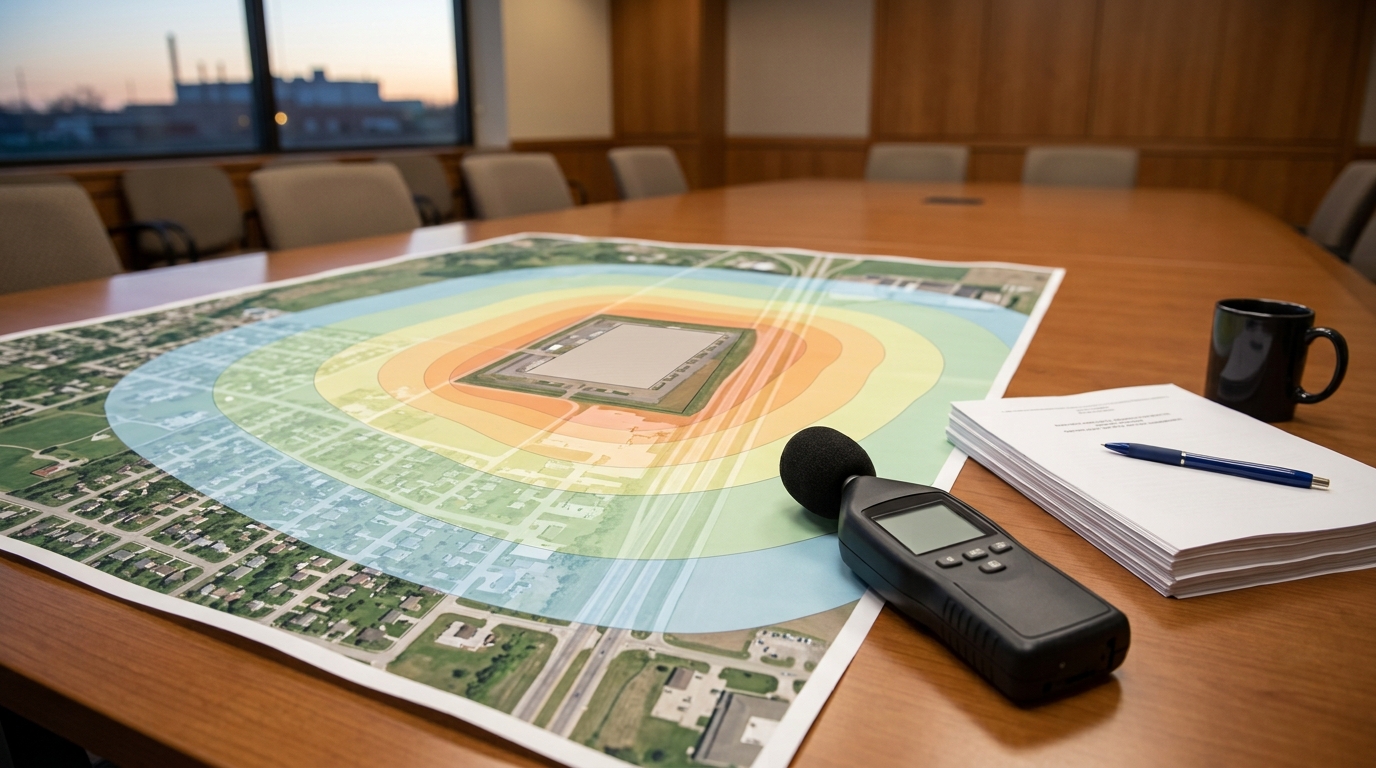
A Good Noise Ordinance Can’t be Created Sitting in a Conference Room
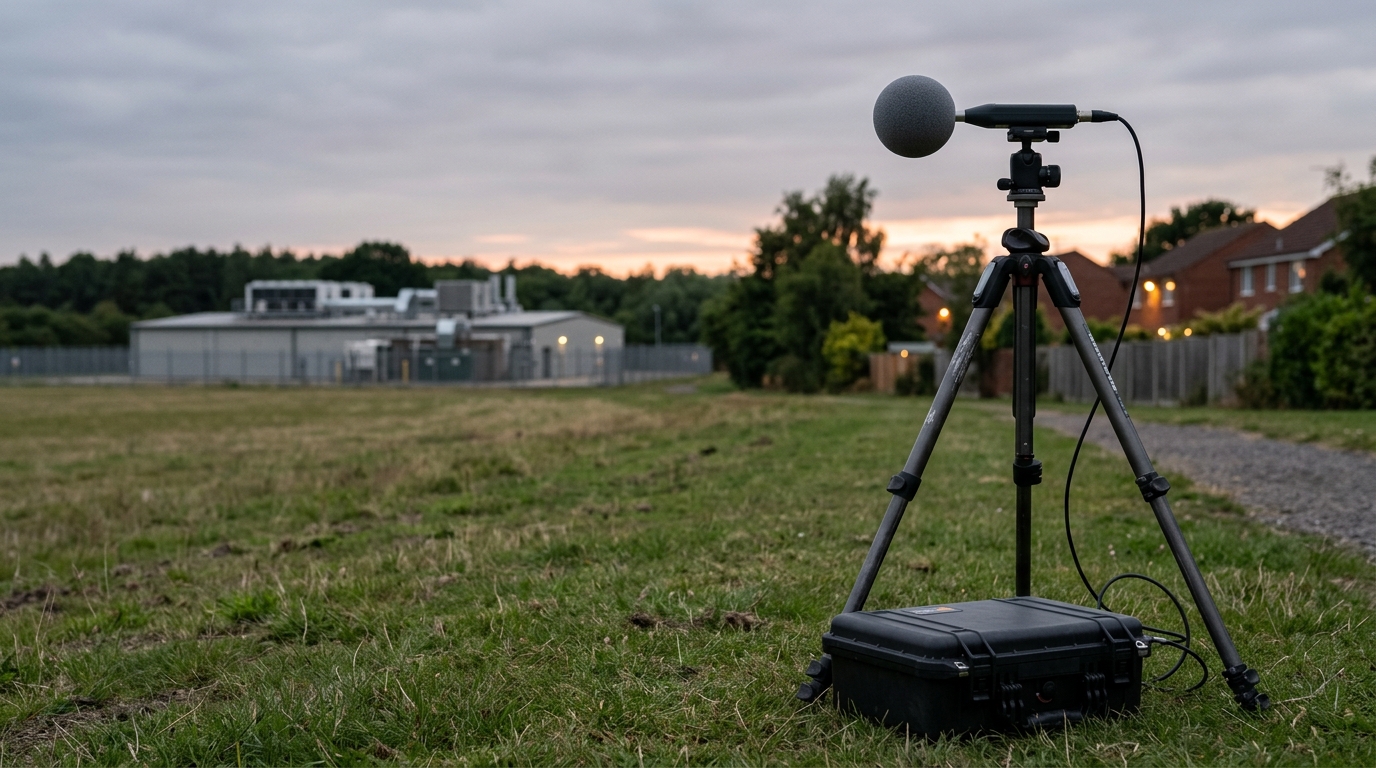
Every community is different, and the unique noise characteristics of each environment must be quantified before realistic limits can be established. Once the general boundaries of current noise-generating activities have been identified (as noted above), an ambient noise study must be undertaken. This effort, discussed in detail in our previous newsletters, involves acquiring current long-term noise data throughout the community and evaluating the resulting statistics. What is the average noise level near residential homes? Near businesses? What peaks or impulse sounds occur? What low-frequency sound energy is present? How far does freeway noise impinge on the community? Are there unexpected noise sources? From these statistics, the analysts can begin to understand the complete characteristics (or ‘signatures’) of noise throughout the community. This will be an essential element in creating a baseline for the new ordinance.
Establishing Limits
This is where real engineering takes place. Starting with the baseline ambient data, a process of generating meaningful noise limits can begin. This usually entails the evaluation of noise concerns and objectionability criteria in the available literature and from published reports. It is also beneficial to review successful city and municipal ordinance metrics from other locations (several excellent ordinances have been published) and optimize them against the ambient noise measurements to determine what makes sense. The limits and metrics will certainly require adjustments to fit the profile of your community. It is also quite possible that some unique requirements be established to ensure that residents are protected from unexpected noise sources. Daytime and nocturnal limits should be determined, along with the required minimum measurement sampling time[1]. Tonal considerations (i.e. a steady annoying ‘note’ from mechanical equipment) are usually included, along with clearly defined limits for impact sounds, and allowable duration periods of intermittent loud noise. From there, the criteria can be adjusted to align with the desires of the community. Statistical data regarding ‘probability of annoyance’ can also be considered in the creation of the ordinance.
Recent environmental findings also should be considered. Significant low-frequency noise (‘hum’ or ‘buzz’) has been documented from some data centers, raising concerns about the impact on residential sleep or well-being. Therefore, ordinances should seriously consider including a “C-Weighted” noise criteria to take this into account.
Balancing Complexity with Practicality
During the ambient noise analysis and subsequent drafting of the ordinance, a lot of complex data will be evaluated, using a variety of advanced engineering metrics. However, it is both unreasonable and impractical to create an ordinance that requires hours for a degreed acoustic engineer to use and evaluate in the field. Therefore, once the key requirements and targets are defined, a simplification process should be undertaken such that the desired outcomes can be achieved using a practical ‘measurement template process’ that can be readily taught to non-experts with an hour or two of training. This training should be repeated annually as a ‘refresher’ class. New sound meters may also be required for enforcement personnel if current equipment is obsolete or is incapable of making the required measurements. There is nothing more frustrating to both residents and community leaders than sending someone out to investigate a noise complaint, only to find out that the individual making the measurements is untrained or using the wrong type of equipment. Unfortunately, this is not an uncommon occurrence.
Legal and Public Review
Once the ordinance criteria and initial wording have been established, a legal team should review the intent and content to ensure that it does not conflict with other community requirements, and that the terms are consistently applied and enforceable.
Enforcement should also be discussed at this time. For many communities, it will be a continuation of previous practices. If an ordinance violation is claimed, the enforcement agencies must be able to validate that the complaint is legitimate. Again, this will mandate that the responsible agencies have capable, calibrated measurement equipment (not their ‘smartphone’) and adequately trained personnel to document the findings, such that the appropriate actions can be taken.
A public review before the issuance of an ordinance is not always mandatory but is advisable. This allows for comment and feedback to be made by business owners and residents. However, this review can’t consist of just ‘technical jargon’; few individuals will fully understand the meaning of “C-Weighted” noise levels, or of a “5 dBA difference in tonal content from adjoining bands”. Therefore, we strongly recommend that a ‘simulation playback’ (using speakers that have been calibrated to approximate actual sound levels) be included in the process. This would include:
- examples of current ambient levels in different areas,
- noise examples that would be considered compliant for the proposed ordinance, and
- noise examples that would not be compliant for the proposed ordinance.
While these examples are approximations, and certainly can’t cover all possibilities, it gives the community an understanding of what can be expected. When well-explained and executed, this can provide solid support for the rollout of the new ordinance.
As with any ‘regulation’, a certain percentage of any population will complain about a noise ordinance, even when the noise is at unmeasurable levels. This can simply be due to someone not wanting to experience any changes in the neighbourhood or could be attributed to a person with highly sensitive hearing. No ordinance can assure that everyone will be happy, but it should be crafted such that a solid majority of the community feels it is fair, reasonable, and that potential violations can be readily verified through direct measurements.
It is also unrealistic to expect that a large plant can come online in a community without creating some degree of new noise. This noise does not have to be an objectionable whine or roaring fans throughout the night…but large facilities will, by nature, create noise…just like street traffic creates noise. This fact should be explained to the community. The goal of a well-considered noise ordinance is not to eliminate noise, but to set reasonable and acceptable limits.
When Completed…
Once the ordinance is complete and issued, it can be provided to new businesses coming into the area, such that they can plan their designs and layouts to ensure compliance, rather than building the plant and waiting to see ‘if any complaints arise’ after it is put into operation (and then fighting with the neighbourhood or going to court).
As with any new ordinance, for the first year following release, it is wise to remain informed about new complaints which may arise, and to be prepared to make ‘adjustments’ to the ordinance criteria should justifiable violations or new sources of objectionable noise become apparent. This process will ensure that the ordinance can stand up to public scrutiny and legal concerns over the long term. A well-written ordinance should stand the test of time and provide true measurable benefit to the community.
How Memtech Acoustics Can Help
A workable ordinance starts with measured data and ends with staff who can enforce it. Memtech Acoustics supports both ends of that process for municipalities:
- Ambient noise studies: Long-term baseline measurements across residential, commercial, and industrial areas, so limits reflect how the community sounds today.
- Ordinance review: An assessment of existing or draft ordinance language for measurable limits, measurement duration, tonal and low-frequency provisions, and enforceability.
- Community noise assessment and modeling: Predicted impacts from proposed facilities, documented for planning commissions, review boards, and public hearings.
- Enforcement training: Practical instruction for the staff who respond to complaints, tailored to your ordinance and your equipment.
When a facility does need mitigation, Memtech engineers, manufactures, and installs noise barriers and acoustic systems, from assessment through installation, backed by more than 25 years of noise and vibration control work.
Is your community reviewing its noise ordinance ahead of a proposed data center? Contact Memtech Acoustics to scope an ambient study or an ordinance review before the site plan reaches your planning commission.