Understanding Noise from Data Centers
With the rapid growth of data center facilities, including crypto mining and other large-scale information processing centers, some misconceptions and ill-founded rumors have become common. These include, to name just a few:
- “Data centers will roar and buzz 24/7 at intolerable levels.”
- “Subsonic (below audible hearing) energy will drive you crazy and cause health problems.”
- “Data center noise has proven to cause insomnia and sleep disorders.”
- “The ground will shake and vibrate your homes.”
- “Sound energy from data centers harms children.”
- “Noise walls will solve these problems.”
Sorting Fact from Rumor
The statements listed above may be true in some cases. The fact is that each data center will have its own unique acoustic footprint, defined by many factors, including:
- The surrounding environment. Hills, reflective buildings, trees, terrain, proximity of residences to the data center, the type of equipment used at the facility, duty cycles (how hard it is running at different times of day), type of plant construction, and proximity to other high-noise sources such as freeways or manufacturing plants will all contribute to the perceived noise from the data center.
- Community expectations. It is a fact that residents in crowded urban centers will be far less sensitive to noise than those who live in rural environments.
- Subjective factors. Studies have proven that trepidation of having a large plant nearby can cause people to become hypervigilant, meaning they experience an increased state of sensory sensitivity. This has been termed the Nocebo Effect: if you believe something bad is going to happen, your brain can make it feel like it’s happening. Peer-reviewed research supports some of these claims. A 2022 systematic review and meta-analysis found a measurable association between noise annoyance and mental health outcomes,3 and separate soundscape research shows that individual sensitivity, not just measured sound level, shapes how noise is perceived.1 Even when no change in sound or vibration levels can be identified across multiple metrics, residents will nonetheless report unbearable noise.
- Limited noise measurements. Many times, noise measurements are made by communities or government agencies that rely on very basic acoustic metrics, such as A-weighted sound pressure level, which can easily overlook the contribution of many critical annoyance factors. More advanced metrics and algorithms are available today to determine the likelihood of community annoyance for any given sound measurement. A-weighted limits are common, but this metric was developed mainly for standardizing perceived noise levels inside buildings or plants. It is not representative of the effects of a low hum being present over large outdoor areas.
Getting Started
When possible, it is highly beneficial to determine the current ambient characteristics of the local environment before a new plant is put into operation. Gathering sound data from various locations surrounding the proposed plant, and in proximity of nearby homes and businesses, will provide a great deal of valuable information. In many instances, the ambient noise levels may already exceed current local ordinances.
For example, a community noise ordinance may state that sound levels above 50 dBA at night are prohibited. If some homes around the plant are near busy streets, commercial businesses, or restaurants, noise levels may already exceed 50 dBA, even before the first footing is laid for the data center building. If that is the case, how can anyone claim that the data center exceeds the ordinance? If a 50 dBA ambient level was present beforehand, it becomes almost impossible to enforce a noise violation in court.
Masking Noise
In addition, comprehensive ambient noise data will provide important information on masking noise. A heavily traveled freeway can mask nearby noise sources, rendering them inaudible. However, this is not always the case.
A recent study involving residential complaints near a large casting plant indicates the importance of performing a thorough ambient data analysis. The residents in this situation were near a major freeway junction and a large international airport. Local authorities could not measure any difference between when the plant was operating and when it was shut down and subsequently determined that there was no problem.
A later, comprehensive ambient noise study revealed that the plant generated a single tone when in operation. This tone had a significantly lower amplitude than the normal ambient background noise. Over time, residents became sensitized to the constant tone (a pipe-organ note) which ran 24/7, and they could clearly discern it over the other loud sounds at night. Noise from the freeways and airport was temporal, changing over time, while the plant tone was constant and never varied. It drove the residents crazy, but it took a lot of analysis to finally find the root cause.
As in this case, if a plant is already in operation, some challenges will arise. Residents often don’t know what the noise levels were in their area before the plant was operational, so it becomes very difficult to claim that the plant noise is disruptive or even different from the previous ambient levels. As shown in this example, some support can be derived from a detailed noise source study, which can directly tie noise radiating from the plant to being the probable source of complaint.
Noise Ordinances: Are They Effective?
It is not unusual for community noise ordinances to be poorly written or arbitrary in nature. Most were written before advanced metrics came into common use, and many are surprisingly copied verbatim from other communities, without even understanding the applicability of the standards to the local area.4
In order to assure community acceptance, a noise ordinance must:
- Be legally supportable. Vague wording or poorly considered noise limits make many ordinances almost impossible to enforce.
- Determine current ambient noise content and characteristics from all sources, including rivers, traffic, and airports. Instances have occurred where chirping crickets exceeded the allowable noise levels by more than 10 dBA.
- Avoid the use of subjective terms, such as “noise must never be annoying to nearby residents.” It is a statistical fact that a certain segment of the population will be annoyed by virtually any sound emanating from nearby sources, regardless of level. It’s not worth chasing every “Mr. Jones’ lawnmower bothers me” claim, because it often isn’t measurable or defensible.
- Consider the adoption of metrics related to low-frequency and tonal noise. Simple A-weighted limits are very limited in overall applicability and effectiveness.
There are many examples of good ordinances in various parts of the country; however, don’t assume you can simply copy someone else’s ordinance. An ordinance that is effective for a suburban Midwest community does not mean it will be applicable for a growing township in the foothills of the Rocky Mountains.
Will the Proposed Data Center Be Annoying?
The answer can vary immensely. There are many data centers that emit very little noise into the community, and there are those that are certainly loud and disturbing. It all depends on the plant design and layout, the types of equipment being used, and the surrounding terrain; some communities report virtually no noise annoyance from data centers, while others find them very problematic.
The only way to understand the community effects of radiated noise is to perform an acoustic modeling study, in which computer simulations are developed. These models can include all individual noise sources (chillers, pumps, generators, etc.), where they are positioned (on the plant roof, inside enclosures, etc.), and the layout of the surrounding community. A well-developed model is very accurate at projecting not only overall A-weighted noise levels, but also other concerns, including low-frequency hum and tonal noise, which can be significant causes of objectionability. In addition, advanced statistical metrics can be applied that consider the probability of annoyance for populations in surrounding communities.
Low-Frequency Noise: Does It Shake the House or Cause Sleep Problems?
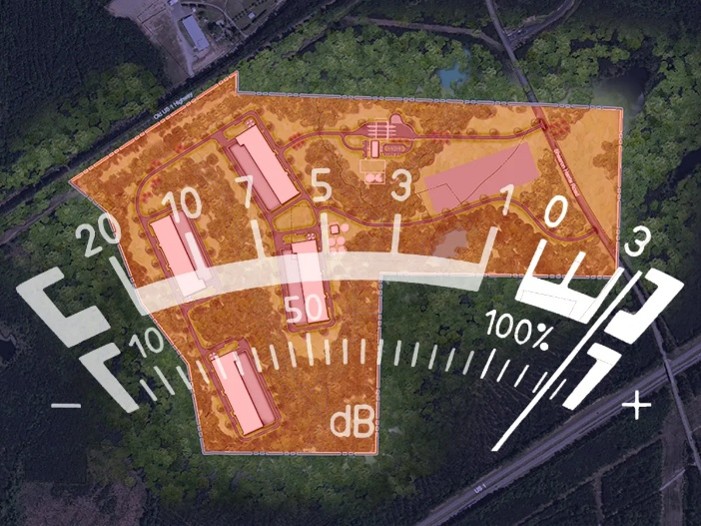
There is no doubt that some data centers can generate significant sound levels at low or very low frequencies.5 Much depends on the type of plant being built, the noise-abatement efforts that have previously been undertaken in the plant design, and the surrounding terrain. However, very few communities have noise ordinances that take low-frequency or tonal noise into account, often making enforcement very difficult. Therefore, it can become difficult to hold data centers accountable for hum or shaking effects at nearby residences. In other instances, plant noise is virtually undetectable even with comprehensive vibro-acoustic measurements; the hypervigilant effect discussed above can result in noise complaints when no significant noise or vibration is present.
There remains a great deal of disagreement within the acoustic engineering community as to the presence and risks of low-frequency noise and vibration around data centers. However, given the large degree of variance in data center designs, it is quite reasonable to assume that some plants are going to produce far more noise, of varying characteristics, than others. Some data centers use only a few chillers, transformers, and generators, whereas large facilities may deploy many hundreds of these systems. Where they are installed and located within the plant, and the inclusion of noise-abatement systems such as enclosures and barriers, will have a major impact on the amplitude and characteristics of radiated noise.
For proposed data centers that are still in the design or approval phase, a good computer simulation can predict the results before the plant comes online. For data centers that are currently in operation, an acoustic mapping study will assist in understanding the characteristics of the objectionable noise, as well as in designing a solution to the problem.
What Can Be Done?
One of the most common scenarios when addressing objectionable noise is for residents to use smartphones or cheap noise meters to document sound pressure levels. These products have virtually no low-frequency response, cannot average noise levels over long periods, and have no capability to isolate different noise sources, such as plant noise, freeways, or commercial activities, from each other.
As a result, a resident may approach authorities with data showing that the plant produces “63 dBA of noise,” which exceeds the ordinance. Not only is that value likely to be incorrect, it may also miss the true cause of annoyance. The microphones used in these products are typically of low quality and lack a true flat frequency response, regardless of what the specifications claim. Properly averaging long data samples and producing a true statistical summary of sustained noise requires specialized, traceable, and defensible instrumentation. When homeowners use smartphones as sound meters to identify and measure the true acoustic characteristics of a community, the results are subject to major errors and can create confusion or misrepresentation.
A qualified acoustics firm can effectively provide a comprehensive assessment of noise within a community; arranging for a long-term noise monitoring study will establish a solid basis for evaluating legitimate complaints, and can be directly correlated to specific noise sources. From there, recommendations for noise mitigation can be proposed, along with the projected improvements resulting from implementing these designs.
As stated above, for proposed data centers not yet built, noise modeling is the most effective process for projecting noise levels and characteristics. Should the results indicate a potential problem in the community, noise mitigation efforts can be undertaken before the plant comes online.
One of the biggest problems acoustic engineers currently face is the lack of low-frequency data for the equipment used at data centers. This often makes projections of hum and rumble difficult and mandates the use of estimated sound power levels below 32 Hz. However, using data acquired from similar plants can provide a good basis for subsequent noise projections.
Noise Mitigation Efforts Must Be Well-Considered
There are many examples where the installation of large noise walls around data centers has resulted in little or no noise improvement in the surrounding communities.6 This is because low-frequency noise can easily diffract over barriers, with little or no reduction on the other side. In addition, the walls are usually located at a considerable distance from the noise sources, further reducing their effectiveness. Noise enclosures, whether partial or complete, can be used for some equipment. Noise barriers should be located close to loud equipment and must be designed to allow for necessary airflow and maintenance access for chillers and similar systems.
There are many other options that may be considered. The primary rule is that it is far less costly and complicated to integrate noise-abatement systems with noisy equipment during the plant design process than to retrofit existing equipment. If noise-mitigation elements are designed into the plant prior to construction, a much better outcome can be expected, with minimal impact on the community.
If You’re Dealing With This Right Now
It is difficult to deal with the complexity and legalities of community noise concerns without expert help. Information, support, and noise remediation designs can be provided when a competent acoustics firm has assessed your specific situation. Assistance can also be provided in drafting comprehensive community noise ordinances, characterizing noise risks in your area, and developing predictive noise models to project the extent of annoyance concerns for data center projects.