When a new Data Center (or any other large industrial/commercial operation) is planned, it is essential to commission a site noise survey prior to the initiation of any work. Why is this necessary?
• It provides solid data to determine what the environment was like prior o the installation of the new facility
• It allows for the development of noise-prediction models to indicate the potential impact of the site when it is in operation (how much noise will be added to current background levels)
• It helps avoid unnecessary legal battles regarding the presence of potentially objectionable new noise sources (i.e. ‘does the plant really generate noise levels that are worse than they were beforehand’).
As stated in the previous newsletter, many data centers produce virtually no audible noise in nearby areas, while others are cause for considerable noise-related annoyance. But without comprehensive documentation of ambient conditions before the plant was built, making a later claim that the ‘noise is really annoying now’ holds negligible legal or negotiating value. It simply becomes someone’s subjective opinion. All that is needed for a counterclaim is that “the noise is no worse now than it was previously”. With no baseline data, establishing such claims becomes a difficult basis for any corrective actions.
Data Collection Requirements
An ambient noise baseline study is typically planned by acoustic engineers and community leaders (with input from residents) to: 1) determine representative locations for data sampling, 2) define necessary test duration periods and 3) consider special conditions or situations where additional data may be required.
The acoustic site survey should be undertaken by qualified professionals with experience in environmental measurements and analysis. This will be essential in the event that litigation or noise-mitigation measures are necessary. Having this analysis undertaken by homeowners or other inexperienced personnel using ‘smartphone’ noise measurement
applications or with inexpensive ‘home grade’ sound meters will certainly result in inaccurate data; and even if the data were accurate, the use of these instruments will rarely hold up under legal scrutiny. If data from these devices is presented during arbitration or litigation matters, it will always be rejected, as these are not certified readings. Regardless of whatever ‘specifications’ are advertised for these home-use products, it is a certainty that they are not traceable or legally admissible into evidence; essential calibration metrics such as repeatability, thermal stability, harmonic distortion, or linearity are never stated for these types of products, and large errors are easily introduced in the measurements. Class 1 or Class 2 sound measurement instruments are very expensive, but provide solid, certifiable data. We have experienced many instances where ‘smartphone’ data has varied as much as 10 dB from acceptable accuracy standards. In addition, other important metrics such as dB (C), peak, L50, etc. are often not available with these systems. If the intent is simply to ‘get a rough idea’ of noise levels, low-cost devices are adequate. But never use them for serious purposes where future scrutiny can be expected.
Noise Metrics
The data to be collected at each selected location should entail much more than the usual “dBA” (known as “A-weighted ") sound pressure values that are stated in most noise ordinances. While this value provides a general summary of perceived noise levels (primarily intended for daytime noise perception while indoors), it fails to include many other noise-annoyance factors. Low-frequency ‘hum’ or ‘roar’ and other sounds such as impacts or constant tones can be averaged out or ignored when using the A-weighted scale. Hearing sensitivities increase during nocturnal periods, and these factors must be considered in any ambient measurement. As a minimum, we recommend that the following metrics be measured at each location:
• A-Weighted Average Sound Pressure – General indicator of noise level • C-Weighted Average Sound Pressure – Considers low frequencies
• Peak Sound Pressure – Measures impacts or sharp transient noises • L10/L50/L90 Statistics – Determines noise levels during quiet periods and gives an indication of noise variability.
Other metrics may also be worth evaluating, depending on location and environmental factors. These are best determined by the acoustic engineers making the study.
Measurement Locations
Measurement positions are typically selected around the proposed plant site (property lines), at sensitive nearby residential areas, or at other locations which may be in direct ‘line-of-sight’ positions from the plant. The number of points to be sampled depends greatly on
the environment and potential impact to the community. For example, if one side of the proposed plant is facing a very quiet residential area, many sample points in the area may be desirable. If the other side of the plant is facing a freeway or large commercial area, one or two points in that area may be adequate, since other noise sources will likely ‘drown out’ the plant noise. Be aware that too few sample locations may miss important local noise sources, and too many can become unnecessarily expensive and time-consuming. This is why a pre-measurement survey is important; the consulting acoustic engineers will travel around the area at random times throughout the day and night to better understand noise sources and directionality, so that sample locations are optimized. This must be completed before any long-term ambient data is acquired.
Adequate Sample Periods
It is unrealistic to assume that a few minutes of noise measurements using a sound level meter will represent the true ambient noise conditions throughout the daytime (rush hour, business activities, freeway traffic) and nocturnal periods (wildlife or sounds from distant sources). It is therefore essential to allow for an adequate sample period to capture representative ambient noise throughout both the day and night. In most cases, a 24-hour sample period is adequate; however, in some situations a much greater sample time period may be necessary to provide a fully characterized sample. Environments with varying commercial activities, cyclic airport traffic, and other factors may require a sample period over several days.
In the event that temporary (atypical) noise sources (ongoing construction, major maintenance activities, etc.) are ongoing in the area, it will be necessary to suspend ambient data acquisition until these activities cease (weekends can be a good alternative). Otherwise, the measured ambient data will be higher than usual and will not provide a good representation of normal background noise levels in the area.
If possible, measurements of ambient noise data can also be sampled during different seasons of the year. Loud crickets, frogs, etc. during the summer can yield higher-than-usual noise levels. Loss of foliage during autumn periods and the presence of snow in the winter can also have significant impacts on ambient noise statistics.
What to Expect
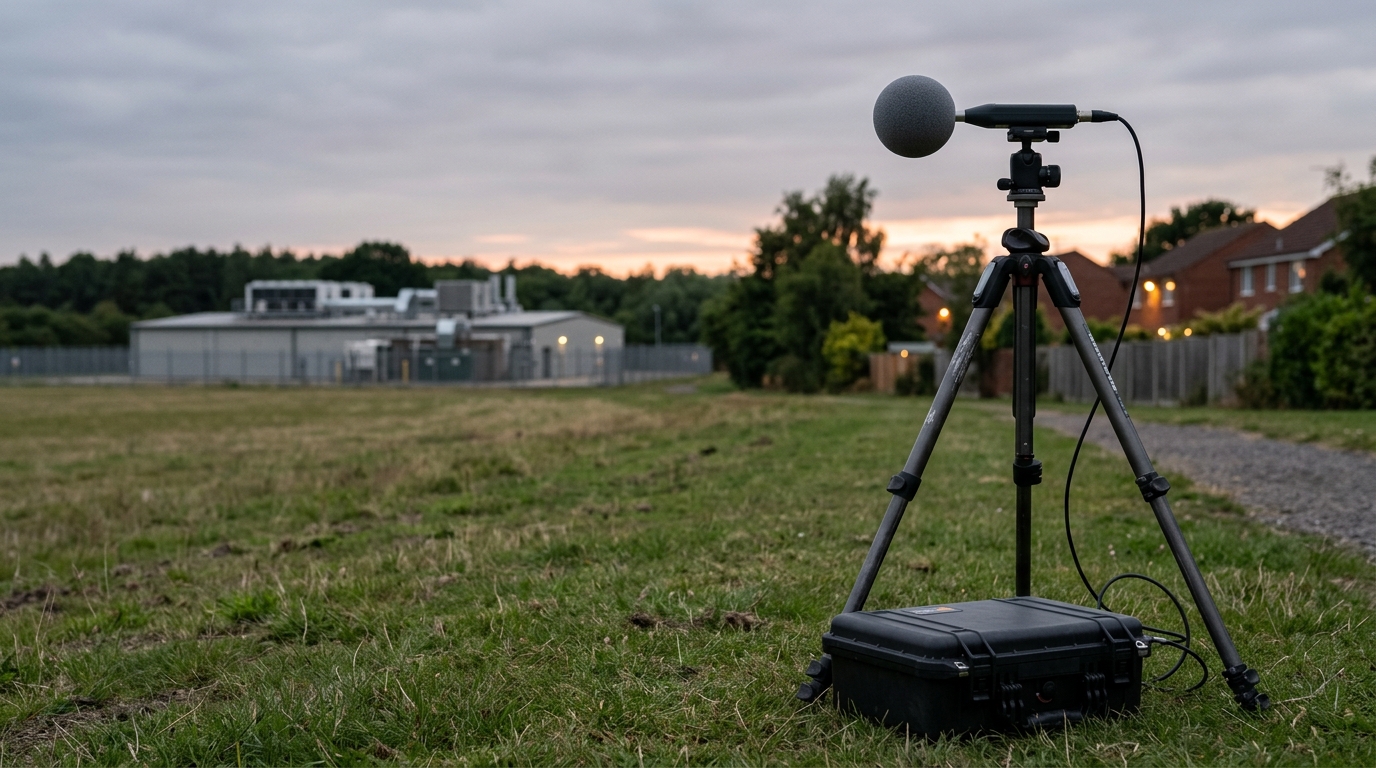
Noise surveys are rarely an inconvenience. In most instances, an engineer or technician will set up tripod-mounted instruments at the specified locations, keeping them out of sight to avoid tampering or theft. They will be left unattended, although it is common for the engineer to return throughout the test period to check on the instruments or to take additional noise samples for verification purposes. It may be necessary to access private
property for these studies, so plans should be made in advance with homeowners and other involved parties (including police departments if necessary). When completed, the instruments will be removed.
What comes out of this?
A properly executed ambient noise study will provide accurate and representative pre-construction background noise data to all stakeholders, including homeowners, communities, developers, and planners. It can be used to determine noise ‘targets’ (how much noise can the plant generate without creating a problem?) as well as to address issues related to noise annoyance once the facilities are in operation. For example, should a new plant generate higher-than-planned levels of noise, the baseline ambient data can be used in negotiations or litigation to indicate pre-construction conditions and to document the worsening levels. Without a solid ambient noise study, it becomes one opinion against another opinion, which can be very difficult to resolve.
The Bottom Line
When a new data center is being planned for your community, it is essential that a comprehensive ambient noise study be planned. Memtech Acoustics has considerable experience with environmental noise studies, working with communities, and in designing cost-effective noise solutions to meet the expectations of nearby residences and businesses.