Clap once in an empty gym and the sound hangs in the air for a few seconds. Clap in a carpeted office and it is gone almost at once. The difference is reverberation time, usually written RT60, and it is one of the most widely used measurements in room acoustics. This article explains what RT60 is, what a reasonable target looks like for different rooms, how it is measured in the field, and what brings it down when a room is too live.
What Reverberation Time Measures
When a sound source stops, the sound in the room does not stop with it. It keeps reflecting off the floor, walls, ceiling and furniture, losing some energy at each surface, until it fades away. Reverberation time is how long that fade takes.
RT60 is the time it takes for the sound level in a room to drop by 60 decibels after the source stops. A 60 dB drop means the sound energy has fallen to one millionth of its starting value. A room with an RT60 of 2 seconds holds onto each sound for about two seconds; a room at 0.5 seconds lets it go in half a second.
Reverberation time is not a single number for a room. It changes with frequency, because materials absorb low, middle and high frequencies differently. A room can be well controlled at 2,000 Hz and still boom at 125 Hz. That is why measured results are reported in octave bands, typically from 125 Hz to 4,000 Hz, rather than as one figure.
To hear the difference, listen to the reverberation demos on our Sound Demos page. They step from 5 seconds (an arena) down to 0.5 seconds (fine dining).
Why Reverberation Time Matters
Some reverberation is useful. It makes speech sound natural and gives music its fullness. Problems start when reflected sound lasts long enough to overlap with what comes next.
- Speech. Each syllable is still reflecting around the room when the next one arrives, so consonants blur together. Teachers, presenters and anyone on a conference call notice it first.
- Busy rooms. In restaurants, cafeterias and gyms, reflected sound layers on top of every conversation. People raise their voices to be understood, and the overall level climbs.
- Music and worship. These rooms are usually designed with longer reverberation than a classroom or office, because music benefits from it. A sanctuary that suits a choir can still be too live for the spoken word in the same service.
Too little reverberation is also a problem. An over-treated room can feel flat and lifeless, which is why the goal is a target, not the lowest possible number.
Typical Reverberation Time Targets
There is no single correct RT60. The right target depends on the room's size and what happens in it.
Classrooms are the one common room type with a published limit. ANSI/ASA S12.60 sets a maximum reverberation time for unoccupied, furnished classrooms of 0.6 seconds for rooms up to 10,000 cubic feet and 0.7 seconds for rooms from 10,000 to 20,000 cubic feet, evaluated in the 500, 1,000 and 2,000 Hz octave bands.
Offices, conference rooms, restaurants and worship spaces have no single code value. For those rooms, Memtech Acoustics sets the target from how the room is used, how large it is and what the owner needs it to do. A recent two-story office, for example, was designed to a 0.8 second target. Music rooms and sanctuaries are usually set longer than rooms built for speech.
What Sets a Room's Reverberation Time
Two things decide RT60: how much air the room holds and how much absorption its surfaces provide. More volume means sound travels farther between reflections and lasts longer. More absorption means each reflection loses more energy and the sound dies away faster.
Wallace Sabine put that relationship into a simple formula more than a century ago:
RT60 = 0.049 × V ÷ A
V is the room volume in cubic feet. A is the total absorption in sabins: each surface's area multiplied by its absorption coefficient, added together. In metric units the constant is 0.161, with volume in cubic meters and absorption in square meters.
The formula explains the patterns people notice. Large rooms with hard finishes, such as gyms, atriums, sanctuaries and converted warehouses, are almost always reverberant. Doubling the absorption in a room roughly halves its reverberation time.
It is an estimate, not a measurement. Sabine's formula assumes sound spreads evenly through the room and absorption is spread evenly across its surfaces. Real rooms rarely work that way: a gym with an absorptive ceiling over a hard floor and hard walls, a room with all of its treatment on one wall, or a space so hard that predicted values at low frequencies run to implausible lengths. A calculation is a useful design tool, and you can run one for your own room with the reverberation time calculator. Before treatment is specified, Memtech Acoustics measures the existing room.
How Reverberation Time Is Measured
Field measurements follow ISO 3382-2, the international method for measuring reverberation time in ordinary rooms, and it is the method Memtech Acoustics uses for RT60 and C50 testing. The process:
- Excite the room with a loud, broadband sound. Memtech Acoustics typically uses a starter pistol, or a balloon burst in small rooms.
- Record the decay with a calibrated Class 1 sound level meter at listening height, away from walls and corners.
- Measure the slope of the decay in each octave band and convert it to a reverberation time.
- Repeat at several source and microphone positions, then average the results.
Measurements are taken with the room unoccupied, furniture in place and building systems running normally, so the result reflects the room people actually use.
Why RT60 is calculated from T20 or T30
Few rooms allow a clean 60 dB decay. Background noise from ventilation, traffic or equipment hides the end of the decay long before it has fallen 60 dB, and no practical test source is loud enough to clear it. So the decay is measured over a shorter range and extended.
- T20 fits a straight line to the decay between 5 and 25 dB below the starting level and extends it to 60 dB. That works out to three times the time taken for the 20 dB drop.
- T30 does the same between 5 and 35 dB below the start, which works out to twice the time taken for the 30 dB drop.
The first 5 dB is skipped because it is dominated by the direct sound and the first reflections rather than the reverberant decay. For example, if the level falls from 5 dB down to 25 dB down in 0.4 seconds, T20 is 0.4 × 3 = 1.2 seconds.

Which one to use depends on how much clean decay the measurement captures above the background noise. ISO 3382 requires the bottom of the evaluation range to sit at least 10 dB above the background, so T20 needs about 35 dB of usable decay and T30 about 45 dB. In noisy rooms, T20 is often the reliable choice. In a room with an even decay, T20 and T30 agree closely. When they differ noticeably, the decay is not uniform, which usually means part of the room is behaving differently from the rest.
Why one measurement is not enough
Sound is not spread evenly through a room, especially at low frequencies, where standing waves make some spots louder than others. A single microphone position can land in one of those spots and give a misleading result. Measuring from several source and microphone positions and averaging them gives a result that represents the whole room. Rooms with distinct zones, such as a stage and an audience area, are measured zone by zone.
Phone apps and single-number meters
An app or a basic meter can give a rough single number, which is enough to confirm that a room is very live. It is not enough to design treatment from. That takes the decay in each octave band, from several positions, with calibrated instruments.
Reverberation Time and Speech Clarity (C50)
Reverberation time tells you how long sound lasts. It does not tell you how much of what reaches a listener helps them understand speech. C50 fills that gap. It compares the sound energy that arrives in the first 50 milliseconds, the direct sound plus the early reflections, with everything that arrives later, expressed in decibels. Higher C50 usually means clearer speech. C80 does the same over the first 80 milliseconds and is used for music. Both come from the same impulse measurement as RT60, so Memtech Acoustics reports them together.
How to Bring Reverberation Time Down
Because RT60 depends on volume and absorption, and volume is rarely negotiable, treatment means adding absorption. What makes it work:
- Enough area. A few panels rarely move the number. The amount of absorption needed follows from the room volume and the target, the same arithmetic as the Sabine formula.
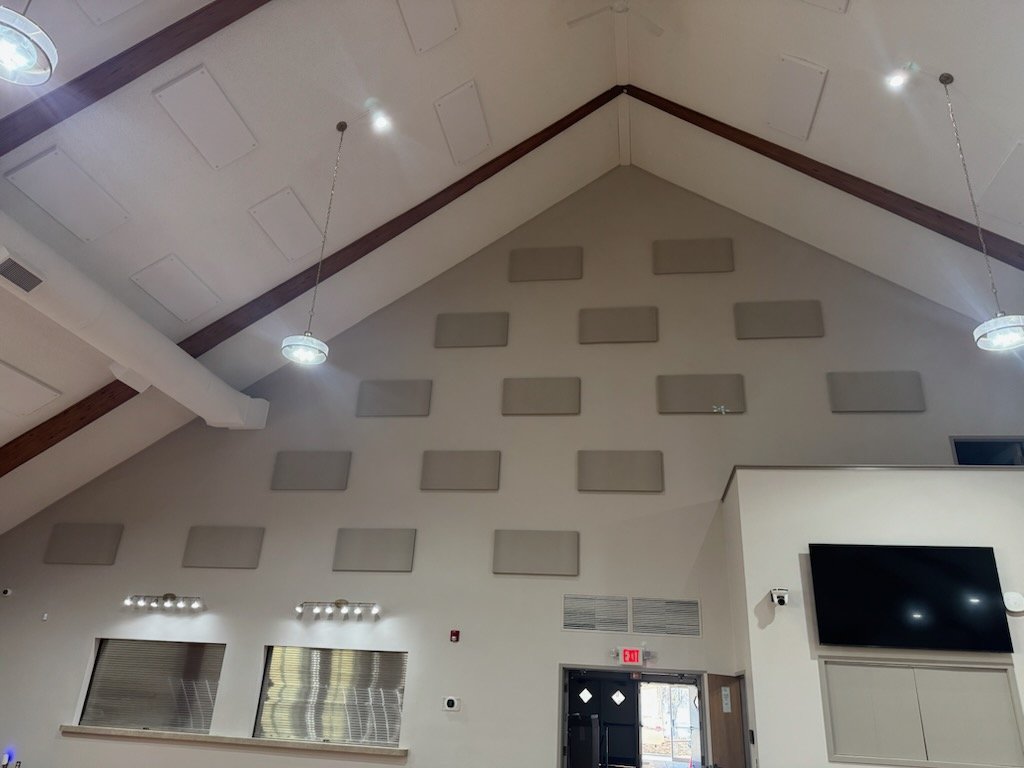
- The right materials for the frequencies. Thin materials absorb high frequencies well and do little in the bass. Thicker wall panels, or panels mounted with an air space behind them, extend absorption into lower frequencies. Compare products by their absorption in each octave band, not only by NRC.
- Placement. Absorption spread across more than one surface works better than the same amount concentrated on one wall, and the ceiling is often the largest surface available.
- Absorption, not blocking. Sound isolation materials such as mass-loaded vinyl or extra layers of drywall keep sound from passing between rooms. They do not shorten reverberation inside a room. The difference between sound absorption and sound blocking covers this in more detail.
Over-treating a room spends money and leaves it sounding dead. Memtech Acoustics models the absorption needed to reach the target before anything is ordered. For panel types, core materials and mounting methods, see The Basics of Reverberation Control.
Measured Results from Recent Projects
Memtech Acoustics measures every room before treatment and, on full packages, measures it again after installation. Recent results:
- Event hall, Grace Emmanuel Baptist Church, Flint: 6.5 seconds before, under 3 seconds after.
- Two-story office, Troy: 0.9 to 1.4 seconds before. After, every space measured 0.55 to 0.77 seconds against a 0.8 second target.
- Restaurant, TRIO Tavern and Grill, Goodrich: up to 1.3 seconds before, 0.7 to 0.74 seconds after.
- Dining hall, Apostolic Christian Church of Livonia: 0.8 seconds before, 0.5 to 0.6 seconds after.
How Memtech Acoustics Can Help
Memtech Acoustics measures reverberation time and C50 to ISO 3382-2, sets a target for how the room is used, models the absorption needed to reach it and specifies the treatment. We supply the materials, coordinate installation through qualified subcontractors and measure again after installation to confirm the room meets its target. For rooms still in design, Memtech Acoustics sets the target and the treatment with the design team through architectural design assist.
If a room is hard to talk in, or you are planning one that has to work for speech or music, send Memtech Acoustics the room's dimensions and how it is used. We will tell you whether a measurement is the right first step.